Updated · By Peter Kovalsky
180 Debate Topics for Middle School, High School and College
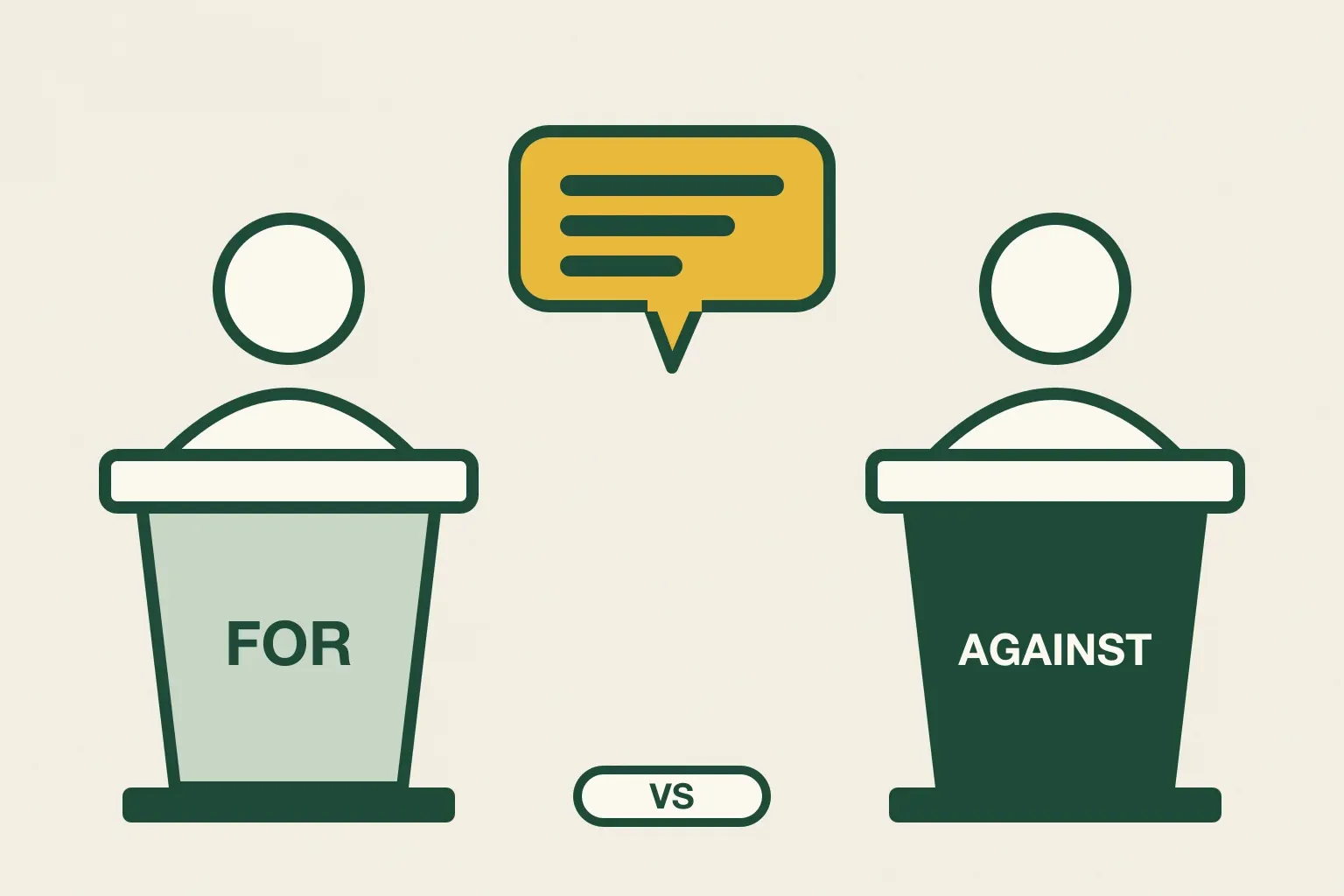
A good debate topic is one that reasonable people disagree about, that both sides can research, and that fits the time your speakers have. This list has 180 of them, sorted first by level (easy, middle school, high school, college) and then by theme. Each one is worded as a motion you can use as written, with a short note on where the clash is, so you can tell at a glance whether it suits your class.
Below the lists you’ll find how to word your own motion, how long the speeches run in the common competition formats, and a simple way to run a debate in class.
What makes a good debate topic?
Before you pick from the lists, check a topic against four questions. If any answer is “no”, pick another or reword it.
| Check | Ask | A topic that fails |
|---|---|---|
| Two real sides | Could a thoughtful person argue either side without embarrassment? | ”Bullying is bad” (no one argues against it) |
| One clear claim | Does it say exactly what changes, and for whom? | ”Technology in schools” (a subject, not a claim) |
| Researchable | Can both sides find evidence at your students’ reading level in the time you give them? | A niche local rule with no public information |
| Fits the time | Can the main arguments be made in the speech length you set? | A whole trade policy in a two-minute speech |
The best topics for younger students are close to their own lives: school rules, homework, games, pets. Older students can handle topics where the evidence is mixed and the argument is really about values, such as privacy against safety or freedom against fairness.
How to word a debate motion
Competitive debate states the topic as a single sentence that one side supports and the other opposes. You’ll see it called a resolution in US formats such as Policy, Lincoln-Douglas and Public Forum, and a motion in World Schools and British Parliamentary debate. Every topic in this guide is worded that way, so either side can take it as is.
- Start with the actor and the action. “Schools should…”, “This house would…”, “Governments should…”. It tells both sides who has to do what.
- Use “should” for policy topics, “is” or “does more good than harm” for value topics. “Zoos should be banned” is a policy question; “Zoos do more good than harm” is a value question. They lead to different arguments.
- Keep one idea per motion. “Schools should ban phones and longer recess” is two debates.
- Avoid loaded words. “Pointless homework should be banned” decides the debate in the wording. “Homework should be banned in elementary school” leaves it open.
- Set the scope. “in public high schools”, “for under-16s”, “in the United States”. A narrower motion is easier to research and harder to dodge.
Easy and fun debate topics
Good first debates for beginners, younger classes, clubs and icebreakers. The stakes are low, so students can focus on structure: a claim, a reason, an example, a rebuttal.
- Cats make better pets than dogs. Independence against loyalty and the work each pet takes.
- Breakfast is the most important meal of the day. Habit and energy against “eat when you’re hungry”.
- It is better to be a morning person than a night owl. Productivity, sleep and whether school times are fair.
- Summer is better than winter. Holidays and outdoor time against cozy months and snow days.
- Books are better than their movies. Imagination and detail against pace and shared experience.
- Pineapple belongs on pizza. A fun warm-up on taste, tradition and who gets to decide.
- Superheroes should reveal their identities. Accountability against safety for their families.
- It is better to be famous than rich. Influence and attention against freedom and privacy.
- Teleportation would be a better superpower than flying. Speed and practical use against the experience itself.
- Every student should learn to cook at school. A life skill against time taken from other subjects.
- Board games are better than video games. Face-to-face play against variety and online friends.
- Living in the city is better than living in the country. Opportunities and transport against space, quiet and cost.
- Aliens have visited Earth. A playful topic that teaches students to weigh evidence and burden of proof.
- Time travel to the past would be better than to the future. Fixing history against seeing what’s coming.
- School should start one hour later. Sleep against transport, after-school jobs and parents’ work.
- Every class should have a class pet. Responsibility and calm against cost, allergies and holiday care.
- Sandwiches are better cut into triangles. A short, silly round for practising rebuttal.
- It is better to be an only child. Attention and resources against company and learning to share.
- Students should be allowed to choose their own seats. Freedom and comfort against focus and inclusion.
- Robots will be better teachers than humans. Patience and personalized pace against care and judgment.
- Homework should be done in class instead of at home. Help on hand against less time for new lessons.
- Ketchup is better than mustard. A quick round on taste where the only evidence is persuasion.
- Every house should have a robot helper. Saved time against cost and doing things yourself.
- Dinosaurs should be brought back to life. Science and wonder against safety and ecozystems.
- Students should get a day off on their birthday. A small reward against missed lessons and fairness.
Debate topics for middle school
Topics for roughly 11 to 14 year olds. Most connect to school life or to things students already have opinions about, and the evidence is easy to find.
- Homework should be banned in middle school. Practice and habits against rest, family time and unequal help at home.
- Students should be allowed phones in class. Learning tools and safety against distraction.
- School uniforms should be required. Equality and focus against self-expression and cost.
- Junk food should be banned from school vending machines. Health against choice and school income.
- Zoos do more good than harm. Conservation and education against animals’ freedom.
- Video games are good for children. Problem solving and friendships against screen time and spending.
- Students should grade their teachers. Feedback and student voice against fairness and grudges.
- Recess should be longer. Movement and focus against lesson time.
- Every student should play a sport. Fitness and teamwork against choice and pressure.
- Social media should be banned for under-13s. Protection against connection and how a ban would work.
- Kids should be paid for good grades. Motivation against learning for its own sake.
- School should be four days a week. Rest and attendance against childcare and lost learning.
- Animals should not be used in testing. Medical progress against animal welfare.
- Students should learn a second language from age five. Easier learning young against a crowded timetable.
- Plastic bags should be banned. Pollution against cost and what replaces them.
- Children should have a set bedtime. Sleep and health against learning to self-manage.
- Field trips are more valuable than classroom lessons. Real-world learning against cost and coverage.
- Cursive writing should still be taught. Reading historic documents and fine motor skills against keyboard time.
- Participation trophies should be given out. Encouragement against rewarding effort the same as results.
- Students should learn about money in school. Practical skills against what families should teach.
- Kids under 12 should not have smartphones. Safety and contact against distraction and harm online.
- Schools should replace textbooks with tablets. Cost and updates against screens and access at home.
- Homework should be optional on weekends. Rest against keeping up.
- Pets should be allowed in school. Wellbeing against allergies and disruption.
- Fast food restaurants should be banned near schools. Health against freedom of choice and local business.
Debate topics for high school
Topics with stronger evidence on both sides and room for values clashes. Many work as persuasive essay prompts too.
- Schools should ban phones for the whole school day. Attention and wellbeing against emergencies and parental contact.
- The voting age should be lowered to 16. Civic habit against readiness and maturity.
- Standardized tests should be dropped from college admissions. Fairness and access against a common yardstick.
- Students should be allowed to use AI tools for homework. A real-world skill against learning to write and think.
- High school should start at 9 a.m. or later. Teen sleep against transport, sport and work schedules.
- Social media does more harm than good to teenagers. Connection and creativity against anxiety and comparison.
- Community service should be required to graduate. Civic skills against forced volunteering.
- College athletes should be paid. Work and revenue against amateur sport and scholarships.
- Year-round schooling is better than a long summer break. Learning loss against rest and family time.
- Grades should be replaced with pass/fail. Less stress and more risk-taking against motivation and signals to colleges.
- Personal finance should be a required class. Life skills against an already full curriculum.
- Schools should teach coding to every student. Future jobs against choice and teacher shortages.
- Fast fashion should be taxed. Waste and working conditions against affordable clothing.
- Cell phone searches by schools should require a warrant. Student privacy against school safety.
- Homework does more harm than good. Practice against stress and unequal home support.
- The minimum driving age should be raised to 18. Road safety against independence and rural needs.
- Single-sex schools are better for students. Focus and confidence against preparation for a mixed world.
- Athletes should be role models. Influence and responsibility against private lives.
- Celebrities should stay out of politics. Free speech and awareness against outsized influence.
- Schools should offer four-day weeks to keep teachers. Recruitment against childcare and learning time.
- Advertising to children should be banned. Protection against free expression and funding for children’s media.
- High school should be optional after age 16. Choice and apprenticeships against lifetime earnings and skills.
- Cheating with AI should be treated like plagiarism. Clear rules against the difficulty of proof.
- Gap years should be encouraged before college. Maturity and direction against momentum and cost.
- Esports should count as a school sport. Teamwork and inclusion against physical activity.
Debate topics for college
Topics for university classes, clubs and competitive practice. They have deep literatures on both sides and reward careful definitions.
- This house would make university tuition free. Access and public good against cost and who really benefits.
- Governments should adopt a universal basic income. Security and automation against cost and the incentive to work.
- Artificial intelligence should be regulated like medicine. Safety testing against innovation and speed.
- Nuclear power is the best path to cutting emissions. Reliable low-carbon energy against cost, waste and build times.
- Social media companies should be liable for user content. Accountability against free speech and moderation at scale.
- Rich countries have a duty to accept climate refugees. Responsibility for emissions against capacity and sovereignty.
- Legacy admissions should be banned. Fairness against donations and community ties.
- The four-day work week should become standard. Wellbeing and productivity against service coverage and pay.
- Billionaires should not exist. Inequality and political power against reward for building companies.
- Facial recognition should be banned in public spaces. Privacy and bias against crime prevention.
- This house regrets the rise of the gig economy. Flexibility against security and workers’ rights.
- Space exploration is worth its cost. Science and inspiration against problems on Earth.
- Voting should be compulsory. Representation against freedom not to vote.
- Genetic editing of embryos should be allowed to prevent disease. Ending inherited illness against consent and designer babies.
- Professors should not share their political views in class. Neutrality against honesty and academic freedom.
- Patents on essential medicines should be suspended in emergencies. Access against incentives to invent.
- Cities should ban private cars from their centers. Clean air and space against access and local business.
- Remote work is better for society than office work. Time and housing costs against mentoring and city centers.
- Developed nations should pay reparations for colonialism. Historic justice against who pays and how much.
- Online anonymity does more good than harm. Protection for the vulnerable against harassment and lies.
- Governments should break up big tech companies. Competition against scale and cheaper services.
- This house supports a carbon tax. Price signals against costs to poorer households.
- Animals should have legal rights. Welfare in law against human use and practical limits.
- Lab-grown meat should replace factory farming. Welfare and emissions against cost, jobs and trust.
- Universities should prioritize free speech over student comfort. Open debate against inclusion and harm.
Debate topics by theme
If your class is studying a subject, pick a theme instead of a level. Most of these work from high school up; reword the scope (for example “in our school”) to make them easier.
Education
- Teachers should be paid based on student results. Accountability against teaching to the test.
- Schools should teach mental health as a subject. Prevention against what schools can do well.
- Online school is as good as in-person school. Flexibility against social learning.
- Exams should be replaced by coursework. Real skills against cheating and fairness.
- Schools should not set homework over holidays. Rest against keeping skills fresh.
- Students should choose what they learn after age 14. Motivation against gaps in the basics.
- Every school should have a debate class. Speaking and reasoning skills against time and staffing.
- Arts subjects matter as much as science. Creativity and culture against job prospects.
- Schools should use AI tutors. Personal help at scale against data, errors and teacher roles.
- Detention does more harm than good. Discipline against lost learning and resentment.
Technology and AI
- AI will create more jobs than it destroys. New industries against automation of routine work.
- Children should not use AI chatbots. Learning help against safety and over-reliance.
- AI-generated art should not be eligible for prizes. Human craft against new tools.
- Self-driving cars should be allowed on all roads. Fewer human errors against liability and edge cases.
- Smartphones have made us less social. Constant contact against shallow connection.
- Tech companies should not collect data on children. Privacy against free services.
- The internet should be a public utility. Equal access against private investment.
- Robots should pay taxes. Funding displaced workers against slowing automation.
- Video games should have age ratings that are legally enforced. Protection against parental choice.
- Deepfakes should be illegal unless clearly labeled. Trust and consent against satire and enforcement.
Environment
- Meat should be taxed to fight climate change. Emissions against food prices and culture.
- Single-use plastics should be banned. Pollution against hygiene and cost.
- Individuals matter more than governments in stopping climate change. Personal choices against systemic policy.
- Electric cars should be required by 2035. Clean transport against cost and charging access.
- Nature should have legal rights. Rivers and forests in court against human use.
- Airports should not expand. Emissions and noise against jobs and travel.
- Fast fashion should be banned. Waste against cheap clothes.
- Zoos are needed to protect endangered species. Breeding programs against life in captivity.
- Rich countries should pay poorer countries for climate damage. Responsibility against fairness to today’s taxpayers.
- Planting trees is the best way to fight climate change. Simple carbon storage against land use and scale.
Health and sport
- Sugary drinks should carry a tax. Public health against personal choice.
- Junk food advertising should be banned on children’s TV. Protection against free speech.
- Tackling should be banned in youth football. Brain safety against the sport itself.
- Performance-enhancing drugs should be allowed in sport. Level playing field against health and fairness.
- Organ donation should be opt-out. Lives saved against consent.
- Energy drinks should be banned for under-16s. Health against age limits that are hard to police.
- Vaccines should be required to attend school. Public health against parental choice.
- Boxing should be banned. Injury risk against consent and discipline.
- Gym class should count towards grades. Valuing fitness against judging bodies.
- Video replay has made sport better. Correct decisions against flow and drama.
Society and ethics
- Lying is sometimes the right thing to do. Kindness and protection against trust.
- People should be judged by their past social media posts. Accountability against growth and context.
- Money can buy happiness. Security and choice against meaning and relationships.
- Children should be responsible for caring for elderly parents. Family duty against personal freedom and state care.
- Cancel culture does more harm than good. Accountability against mob justice.
- Tipping should be replaced by fair wages. Clear prices against rewarding good service.
- Influencers should have to label every paid post. Honesty against overreach.
- Graffiti is art. Public expression against property and permission.
- Historical statues of controversial figures should be removed. Who we honor against erasing history.
- Happiness matters more than success. Wellbeing against ambition.
Economics and work
- The minimum wage should be raised. Living costs against jobs and prices.
- Unpaid internships should be banned. Fair access against opportunities offered.
- Everyone should have the right to work from home. Flexibility against roles that need presence.
- Stores should not open on Sundays. Rest and community against jobs and convenience.
- The retirement age should rise. Longer lives and pension costs against physical jobs.
- Cash should be replaced by digital money. Efficiency against privacy and people without bank accounts.
- CEO pay should be capped. Fairness against attracting talent.
- Tourism does more harm than good to popular cities. Income against housing and crowds.
- Companies should be required to report their gender pay gap. Transparency against misleading averages.
- Buying second-hand should be encouraged with tax breaks. Less waste against new-goods jobs.
Government and law
- Jury trials should be replaced by judges. Expertise against judgment by peers.
- Prisons should focus on rehabilitation over punishment. Lower reoffending against justice for victims.
- Term limits should apply to all elected officials. Fresh ideas against experience.
- Public figures should lose some right to privacy. Accountability against intrusion.
- Election campaigns should be publicly funded. Less donor influence against public cost.
- National service should be required for young adults. Shared purpose against freedom.
- Police should wear body cameras at all times. Accountability against privacy.
- Countries should have open borders. Freedom of movement against public services and security.
- The death penalty should be abolished everywhere. Irreversible mistakes against justice for the worst crimes.
- Online voting should replace polling stations. Turnout against security and trust.
Controversial debate topics
These are among the most debated questions in politics and ethics. They make strong rounds for experienced debaters, but people in the room may hold these views personally or be affected by them. Set ground rules first: argue the motion, not the person; everyone may be assigned either side; evidence over anecdote.
- Abortion should be legal in all circumstances. Bodily autonomy against the moral status of the fetus.
- Gun ownership should require a licence and training. Safety against the right to bear arms.
- Euthanasia should be legal for terminally ill adults. Choice and dignity against pressure on the vulnerable.
- Recreational cannabis should be legal. Regulation and tax against health risks.
- Religion does more good than harm. Community and meaning against conflict and exclusion.
- Hate speech should be illegal. Protection from harm against free expression and who defines it.
- Affirmative action in admissions is fair. Correcting unequal access against judging by group.
- Immigration should be reduced. Wages and services against growth and labor shortages.
- Torture is justified to stop an imminent attack. Lives saved against absolute human rights.
- Surveillance is a fair price for security. Safety against privacy and abuse of power.
How long are debate speeches?
Class debates set their own times; two to four minutes per speaker is a common choice. Competitive formats are fixed. These are the times the US National Speech & Debate Association lists for each event, as of November 2026:
| Format | Teams | Speeches | Topic |
|---|---|---|---|
| Public Forum | Two against two | Constructives and rebuttals 4 min, summaries 3 min, final focus 2 min, crossfires 3 min; 3 min prep per team | Current events; resolutions change often through the season |
| Lincoln-Douglas | One against one | Affirmative constructive 6 min, negative constructive 7 min, rebuttals 6, 4 and 3 min, cross-examinations 3 min; 4 min prep each | Values: morality, philosophy and justice |
| Policy | Two against two | Constructives 8 min, rebuttals 5 min, cross-examinations 3 min; 8 min prep per team | One federal policy resolution for the whole year |
| World Schools | Three against three | Six 8-minute speeches and two 4-minute replies | Prepared and impromptu motions on real-world issues |
To see how much a speaker can say in that time, use the speech length pages: a 2-minute speech, 3-minute speech, 4-minute speech, 6-minute speech or 7-minute speech, or paste a draft into the speech time calculator.
How to run a debate in class
A simple format that fits a 45 to 50 minute lesson with two teams of three:
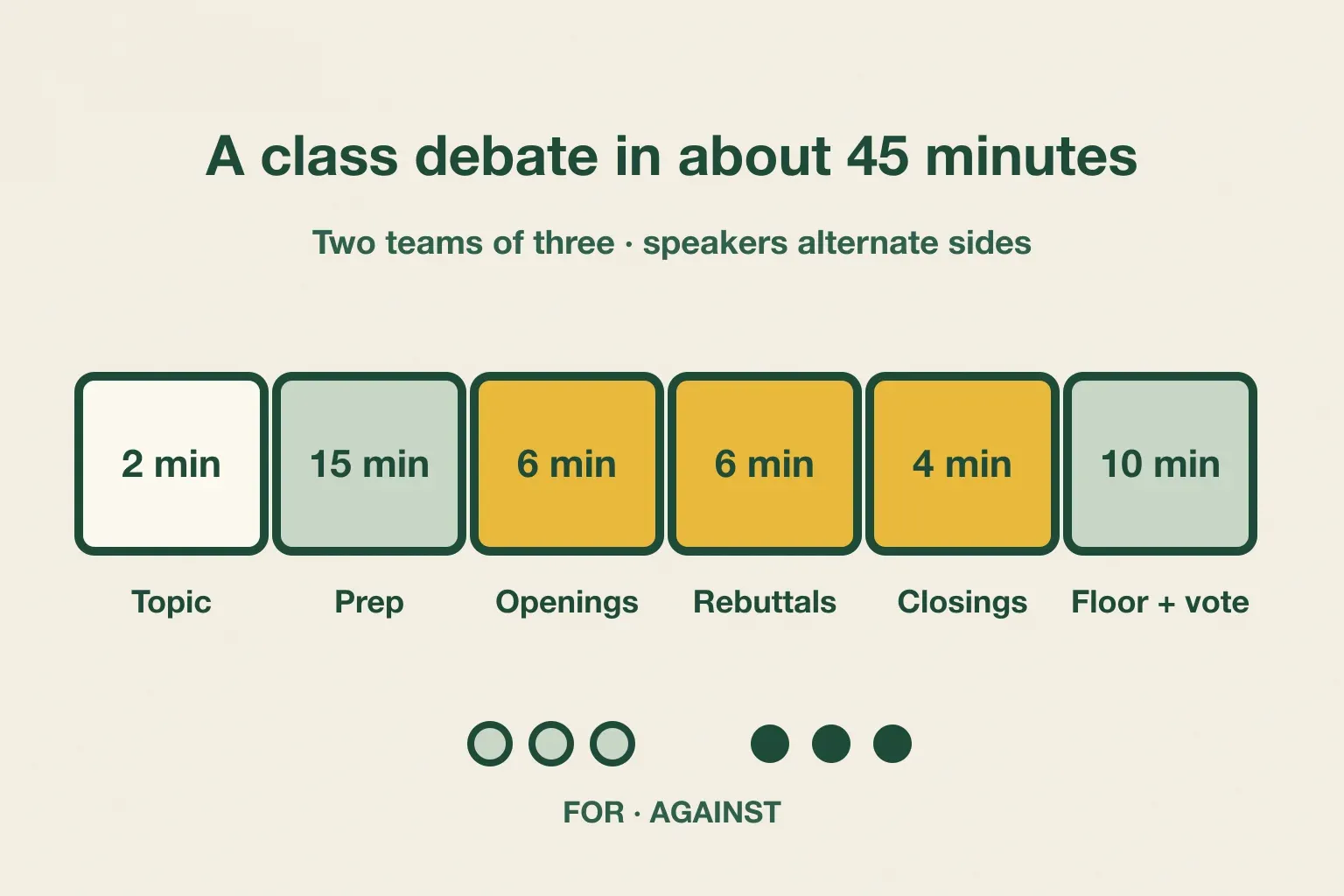
- Pick the motion and assign sides at random (about 2 minutes). Assigning sides means students argue the case, not just their own opinion. A coin flip or the random group generator keeps it fair.
- Prep (10 to 15 minutes). Each team agrees on two or three main arguments and guesses the other side’s best point.
- Opening speeches (3 minutes each, alternating sides). First speakers set out their case.
- Rebuttal speeches (3 minutes each). Second speakers answer the other side’s arguments directly.
- Closing speeches (2 minutes each). Third speakers sum up why their side won the clash, with no new arguments.
- Questions from the floor and a vote (5 to 10 minutes). The audience votes on who argued better, not on what they believed before.
Time every speech with a clock the whole room can see, such as a full-screen speech timer, so speakers can pace themselves and nobody argues about who went over. Give a 30-second warning and stop each speaker at the bell; it is the most useful habit a beginner can learn. To grade the round, adapt a presentation rubric with rows for argument, evidence, rebuttal and delivery.
Prepare a debate speech
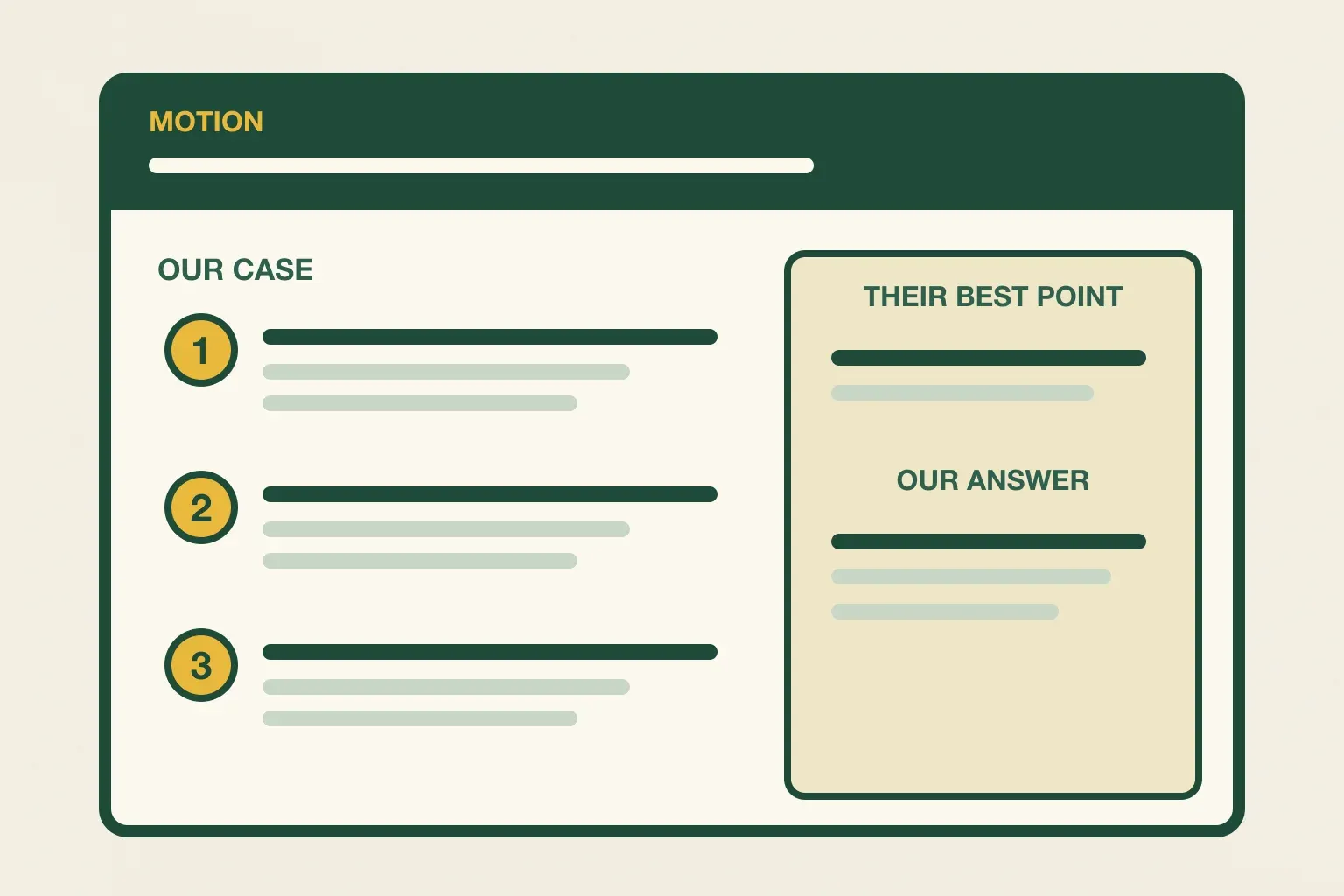
Whichever topic you get, the same structure works:
- Define the key words of the motion so the debate is about the same thing. “Phones” in a phone ban: smartphones only, or smartwatches too?
- Choose two or three arguments, each with a reason and one piece of evidence or an example. Three solid points beat six thin ones.
- Prepare for the other side. Write down their best argument and your answer to it before the round starts.
- Write cue cards, not a script. Key words and numbers only, so you can look up and respond. The cue card maker formats them for printing.
- Rehearse out loud with a timer. A case that reads well on paper often runs over when spoken.
For impromptu rounds, where you get a motion with little or no prep, practice with the impromptu speech topic generator: draw a topic, take one minute to plan, and speak for two.
If teams present slides in a class debate, for example a policy proposal or a research project, Copresent lets each speaker move a shared Google Slides deck forward from their own phone and read their speaker notes there. The host runs the extension in Chrome; teammates join from a link, with no account or install. See how to co-present in Google Slides.
Frequently asked questions
Which topic is best for debate?
The best debate topic has two genuinely arguable sides, is close to your audience’s interests, and can be researched in the time you have. For a first debate, pick something from school life, such as homework or phone rules. For experienced debaters, values topics such as privacy against security give the richest clash.
What is a funny debate topic?
Light topics such as “Pineapple belongs on pizza”, “Cats make better pets than dogs” or “Teleportation would be a better superpower than flying” work well. They are easy to argue without research, so students can practice structure and rebuttal without worrying about evidence.
What are good debate topics for high school students?
Topics that affect teenagers directly and have evidence on both sides: banning phones for the school day, lowering the voting age to 16, later school start times, whether students may use AI for homework, and paying college athletes. The high school list above has 25 more.
How long should a debate speech be?
In class, two to four minutes per speaker is typical. In competition it depends on the format: Public Forum constructives are 4 minutes, a Lincoln-Douglas affirmative constructive is 6 minutes, Policy constructives and World Schools speeches are 8 minutes.
How do you write a debate motion?
State one claim in one sentence, with who acts and what changes: “Schools should ban phones during lessons.” Use “should” for a policy and “is” or “does more good than harm” for a value judgment, keep it to one idea, and avoid loaded words that settle the question in advance.