Updated · By Peter Kovalsky
150 Persuasive Speech Topics for Middle School, High School and College
A good persuasive speech topic is one you believe in, that your audience doesn’t already agree with, and that ends in something they can do or decide. This list has 150 of them, sorted by level (easy, middle school, high school, college) and then by theme. Each one is written as a claim you can argue as is, with a one-line angle: the reason that carries the speech and what you are asking the audience to do.
Below the lists you’ll find how to turn any topic into a claim, a five-step structure for the speech, how many words fit in 3 or 5 minutes, and how to practice it.
What makes a good persuasive speech topic?
Check a topic against these four questions before you write. If one answer is “no”, pick another topic or narrow it.
| Check | Ask | A topic that fails |
|---|---|---|
| You care about it | Could you talk about it for five minutes without notes? | A topic picked only because it was first on a list |
| Someone disagrees | Would at least some of your audience start on the other side? | ”Reading is good for you” (everyone already agrees) |
| There is an ask | Can the audience do, support or decide something at the end? | ”The history of the bicycle” (that is an informative topic) |
| It fits the time | Can you make two or three strong points in your time limit? | ”Fix the health care system” in three minutes |
The best topics for a class are close to the audience’s own life. Your classmates can’t change national law, but they can sign a petition, change a habit, vote in a student election or ask the school to try something. A speech that ends with a small, clear action is more persuasive than one that ends with “someone should do something”.
Turn a topic into a claim
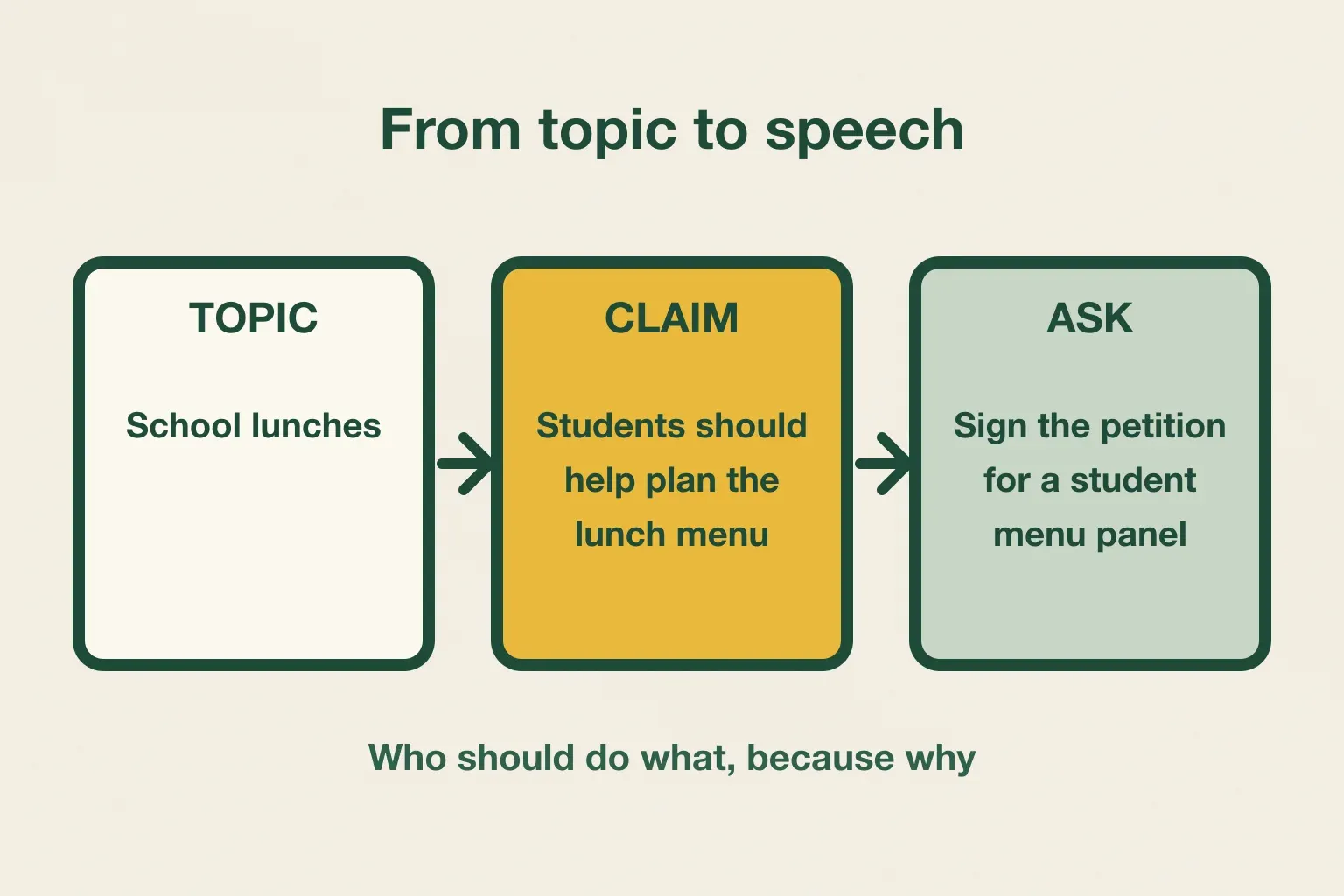
A topic is a subject (“school lunches”). A persuasive speech needs a claim: one sentence that says what you want the audience to believe or do (“Our school should let students help plan the lunch menu”). Claims come in three kinds, and each leads to a different speech.
- Fact: is it true? “Most teenagers don’t get enough sleep on school nights.” You win by showing evidence.
- Value: is it good or bad? “Zoos do more good than harm.” You win by setting a standard (animal welfare, conservation) and showing the topic meets it.
- Policy: what should we do? “Our school should start at 9 a.m.” You win by showing a problem, a fix that works, and that the fix is worth its cost.
Policy claims are the easiest to make persuasive, because they end in an action. A simple template works for almost every topic on this page:
[Who] should [do what], because [your strongest reason].
“Students should take one screen-free evening a week, because it improves sleep and focus.” Write your claim on a card first. If you can’t fill in the template, the topic is still too broad.
Easy persuasive speech topics
Good for a first speech, younger students or a short warm-up. Everyone has an opinion on these, so you can focus on structure: a claim, a reason, an example and an ask.
- Everyone should learn to swim. A life skill that prevents accidents; ask families to sign up for lessons.
- Kids should have a regular chore at home. Responsibility and fairness; ask listeners to pick one chore this week.
- Reading for fun is better than watching TV. Imagination and vocabulary; suggest 20 minutes of reading before bed.
- Every school should have a garden. Fresh food, science lessons and time outdoors.
- Recycling bins should be in every classroom. Small habits add up; ask the class to sort waste for a month.
- Dogs are the best pets for families. Exercise, company and learning to care for an animal.
- Students should drink water instead of soda. Health and energy; ask for a one-week soda swap.
- Board game nights are good for families. Talking, teamwork and time away from screens.
- Everyone should learn basic first aid. You might help a friend one day; ask the school for a short course.
- Kids should spend more time playing outside. Fitness, mood and fresh air beat another hour indoors.
- Libraries are still important. Free books, quiet space and help for everyone.
- Being kind is more important than being popular. Real friendships last; ask listeners to include someone new.
- Every student should learn to play an instrument. Patience, memory and joy.
- Breakfast should be served free at school. Hungry students can’t focus.
- Kids should help choose class rules. People follow rules they helped make.
- Walking or biking to school is better than driving. Exercise, less traffic and time with friends.
- Everyone should have a library card. It costs nothing and opens thousands of books.
- Students should learn to cook simple meals. A skill for life and a healthier diet.
- Pets should be adopted from shelters. Saves an animal and costs less; ask families to visit a shelter first.
- Saying thank you makes a difference. Gratitude builds friendships; ask everyone to thank one person today.
Persuasive speech topics for middle school
Topics for roughly 11 to 14 year olds. Most connect to school and home life, and the evidence is easy to find and understand.
- Our school should have longer lunch breaks. Time to eat slowly and rest makes afternoon lessons better.
- Students should be allowed to listen to music while working. It helps some students focus during quiet work.
- Kids under 13 should not use social media. Protection from pressure and strangers; ask parents to wait.
- School should teach typing in every grade. Most schoolwork is now done on a keyboard.
- Every class should get a weekly free reading period. Reading for pleasure grows when there’s time for it.
- Plastic water bottles should be replaced with refill stations. Less waste and cheaper over time.
- Students should be able to retake tests. Learning matters more than one bad day.
- Kids should earn an allowance for chores. It teaches money and effort together.
- Schools should have later start times. Teens are wired to sleep later; ask the board to pilot it.
- Video games can teach useful skills. Problem solving, teamwork and planning, in the right amount.
- Every student should learn coding. Logic and problem solving help in any job.
- Students should have a say in the school dress code. Rules feel fair when students help write them.
- Animals in circuses should be retired. Travel and training are hard on them.
- Homework should be limited to 30 minutes a night. Time for rest, family and hobbies.
- Schools should offer more clubs at lunchtime. Students who take the bus can’t stay after school.
- Cyberbullying should be treated as seriously as bullying at school. The harm is the same; ask for a clear way to report it.
- Gym class should offer more choices. Students move more when they enjoy the activity.
- Kids should learn about money before high school. Saving and spending habits start early.
- Every student should have a reusable lunch box. It cuts trash every single day.
- School assemblies should include student speakers. Students listen to their peers.
Persuasive speech topics for high school
Topics with real evidence on both sides, so you will need to answer the best objection, not only state your view. Many work as persuasive essay prompts too.
- High schools should teach personal finance as a required class. Taxes, credit and loans affect every graduate.
- Students should get a mental health day each semester. Rest prevents burnout; ask the school to add it to the attendance policy.
- The school day should start at 8:30 a.m. or later. The American Academy of Pediatrics recommends it for teen sleep.
- Phones should be stored in lockers during class. Fewer distractions and less pressure to check notifications.
- Schools should teach students how to spot misinformation online. Everyone reads the news on their phone now.
- Driver’s ed should be free in public high schools. Safer new drivers, and fair access for every family.
- Students should be allowed to use AI for brainstorming, but not for writing. A useful tool, with a clear line on honesty.
- Every high school should offer a gap year advisor. A year of work or service can help students choose better.
- Fast fashion should be avoided. The environmental and labor costs are hidden; ask listeners to buy one item secondhand.
- Teen athletes should have a limit on practice hours. Overuse injuries and burnout are common.
- Every student should register to vote at 18. Young people vote less; ask classmates to pre-register where their state allows it.
- Schools should replace one exam with a project. Projects test skills that exams can’t.
- Part-time jobs are good for high school students. Money skills, responsibility and references for later.
- Energy drinks should not be sold to teens. High caffeine and sugar; ask the school store to stop stocking them.
- Schools should start a free tutoring program run by students. Tutors learn too, and it costs the school very little.
- Learning a trade is as valuable as going to college. Good pay, less debt and skills in demand.
- Social media apps should turn off endless scrolling for teens by default. Design choices keep people online longer.
- Grades should include effort and improvement. Students who grow should get credit for it.
- Every high school should have a recycling and compost program. A visible, daily climate action students can run.
- Students should learn first aid and CPR before graduating. A skill that saves lives in an emergency.
- Group projects should include peer grading. It rewards those who do the work.
- Schools should offer more classes online. Flexibility for students with jobs, health needs or long commutes.
- Teenagers should limit screen time before bed. Better sleep, better mood; ask for a one-week trial.
- Community service should count toward graduation. It builds skills and connects students to their town.
- Volunteering abroad does less good than volunteering at home. Local help often lasts longer; ask listeners to start nearby.
Persuasive speech topics for college
Topics for public speaking classes and college presentations. Expect a mixed audience and use evidence they can check.
- College textbooks should be free digital editions. Cost keeps students from buying required books.
- Universities should cap class sizes for first-year courses. Smaller classes help students stay enrolled.
- Unpaid internships should be banned. Only students who can afford to work for free get the experience.
- Every campus should offer free mental health counseling. Waiting lists turn small problems into crises.
- Students should take a public speaking course before graduating. Almost every job asks people to present.
- Attendance shouldn’t be part of the grade. Adults should be graded on what they learn.
- Cities should make public transport free for students. Cheaper commutes and fewer cars.
- Universities should divest from fossil fuels. Endowments signal values; ask students to join the campaign.
- A four-day work week would make people more productive. Point to company pilots that kept output steady with happier staff.
- Remote work should be the default for jobs that allow it. Saves commuting time and widens who can apply.
- Tipping should be replaced by fair wages. Pay shouldn’t depend on a customer’s mood.
- Everyone should be an organ donor by default. Argue that opt-out systems raise the number of donors.
- Colleges should accept more transfer credits. Students shouldn’t pay twice for the same course.
- Laptops should be optional in lecture halls. Some studies suggest handwritten notes help students remember.
- Students should learn to negotiate their first salary. A small ask early adds up over a career.
- Campus dining should label the carbon cost of meals. Information changes choices without banning anything.
- Credit cards shouldn’t be marketed on campus. Debt starts early and grows fast.
- Every degree should include a semester of work experience. Employers want it and students learn what they like.
- Universities should publish the real cost of each degree. Students deserve to compare before they enroll.
- AI tools should be taught, not banned, in college. Graduates will use them at work.
Fun and funny persuasive speech topics
Light topics still need a real argument. They’re good for a first speech, a club or a persuasive speech with a strict time limit, because nobody needs research to follow you.
- Cereal is a soup. Liquid, solids, a bowl and a spoon; argue it with a straight face.
- Socks with sandals should be fashionable. Comfort over style, with a confident delivery.
- Naps should be required for adults. Short naps help mood and focus.
- Pancakes are better than waffles. Fluffiness, toppings and fewer dishes.
- Every school should have a pajama day once a month. Comfort and fun for a small cost.
- Cats secretly run the house. A fun way to practice evidence and examples.
- Dessert should be eaten first. You’re hungriest at the start, and you enjoy it more.
- Hot dogs are sandwiches. A classic for practicing definitions.
- Homework should be replaced with video games. Funny on the surface, with a real point about learning by doing.
- Monday should be part of the weekend. A three-day weekend for a happier week.
- Everyone should own a rubber duck. Explaining a problem to a duck helps you solve it.
- Teachers should wear capes. Every superhero needs a uniform.
- Water is the best drink in the world. It does everything and costs almost nothing.
- Elevators should play only one song. A fun case for shared traditions.
- Pizza should be a breakfast food. Bread, cheese and tomato is close to a breakfast already.
Persuasive speech topics by theme
Pick a theme you already know about, so your examples come from real life rather than the first search result.
Technology and AI
- Kids under 14 shouldn’t have smartphones. A basic phone covers safety without the apps.
- AI-generated images should be labeled. People deserve to know what is real.
- Everyone should use a password manager. Reused passwords are the easiest way to get hacked; ask listeners to set one up.
- Tech companies should let users download all their data. Your photos and posts belong to you.
- Self-driving cars should be allowed only after strict public testing. Safety must be proven before trust.
- Notifications should be off by default. Apps should earn your attention.
- Phones should come with a “focus mode” turned on at night. Better sleep without willpower.
- Schools should teach how algorithms choose what we see. Understanding the feed makes people harder to manipulate.
- Everyone should back up their photos twice. Losing a phone shouldn’t mean losing years of memories.
- Online accounts should be easy to delete. Signing up takes a minute, so leaving should too.
Environment
- Food waste should be composted in every city. Less landfill and free soil for gardens.
- Single-use plastic cutlery should be banned. It is used for minutes and lasts far longer in landfill.
- Everyone should eat one plant-based meal a day. A small change with a real effect on emissions.
- Cities should plant more trees on streets. Shade, cleaner air and cooler summers.
- Fast fashion brands should pay for recycling their clothes. The maker should handle the waste.
- Schools should turn off lights and screens at night. Saving energy is also saving money.
- Lawns should be replaced with native plants. Less water and more bees.
- Products should be built to be repaired. A right to repair saves money and waste.
- Every household should switch to LED bulbs. Cheap, quick and long-lasting.
- Car-free days should be held in city centers. People see what streets could be.
Health and sport
- Teenagers need at least eight hours of sleep. Sleep affects grades, mood and safety.
- Sugary drinks should carry warning labels. Clear information helps people choose.
- Youth sports should focus on fun before winning. Kids who enjoy sport keep playing for life.
- Everyone should take the stairs. Free exercise built into the day.
- Headers should be limited in youth soccer. Protect developing brains; ask coaches to follow age rules.
- Schools should teach mental health like physical health. Knowing the signs helps students ask for help.
- Walking meetings are better than sitting meetings. Movement helps thinking.
- Esports should count as a school sport. Teamwork, practice and strategy are the same.
- Everyone should learn to cook five healthy meals. Cooking at home saves money and improves diet.
- Gyms should offer free classes for teenagers. Healthy habits start young.
Money and work
- Everyone should start saving with their first paycheck. Small amounts grow over time.
- Buy-now-pay-later should be used with caution. Easy credit hides real debt.
- Students should make a monthly budget. Knowing where money goes is the first step to control it.
- Job ads should show the salary range. It saves time and makes pay fairer.
- Side hustles are a good way to learn business. Low risk and real customers.
- Shopping locally keeps money in the community. Ask listeners to buy one gift from a local shop.
- Subscriptions should be easy to cancel. One click in should mean one click out.
- Everyone should have an emergency fund. A small cushion prevents big debt.
- Internships should be paid. Work deserves pay, and it opens doors to more students.
- Teenagers should learn how credit scores work. It affects renting, loans and even jobs.
Controversial persuasive speech topics
These topics divide people strongly. They can make a powerful speech, but check with your teacher first, stick to evidence, and treat the other side with respect. You are trying to move people who disagree, not to win applause from those who already agree.
- The voting age should be lowered to 16. Teens pay taxes and live with the results of elections.
- Social media platforms should verify the age of every user. Child safety against privacy.
- College sports should be separated from universities. The money has outgrown the classroom.
- Zoos should focus only on endangered species. Conservation as the reason to keep animals.
- Standardized tests should be dropped from college admissions. Fairness against a common measure.
- Cars should be banned from city centers. Cleaner air against access and local business.
- Schools should use AI to grade essays. Faster feedback against fairness and nuance.
- Daylight saving time should end. Health and safety against lighter evenings.
- Fast food advertising aimed at children should be banned. Health against free speech.
- Billionaires should pay a higher tax rate. Fairness and public services against growth and investment.
How to structure a persuasive speech
A widely taught structure for persuasive speeches is Monroe’s Motivated Sequence, developed by Alan H. Monroe. It has five steps, in this order:
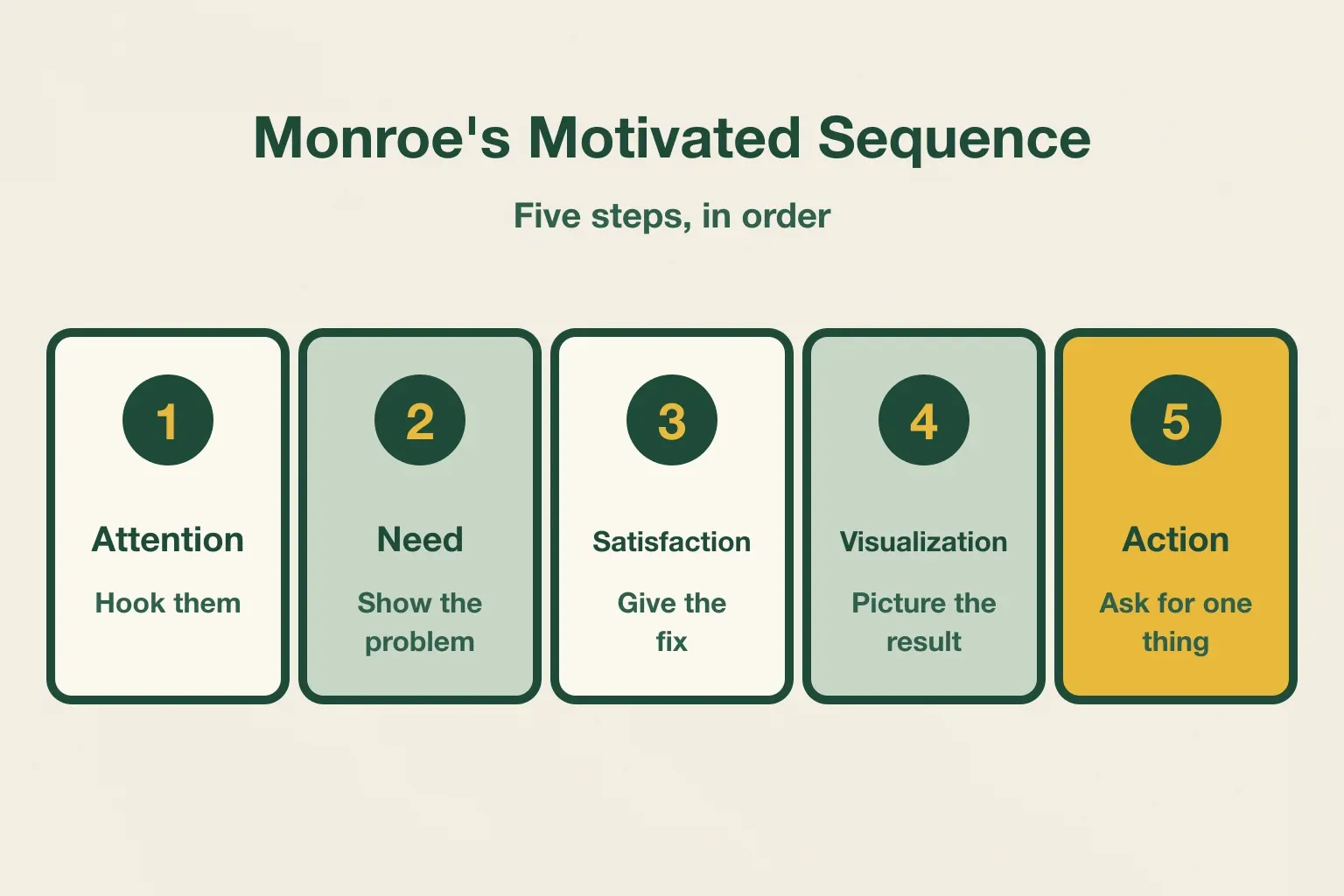
- Attention. Open with a question, a short story, a surprising fact or a picture. “Raise your hand if you checked your phone in the last ten minutes.”
- Need. Show the problem and why it matters to this audience. Use one fact and one example they recognize.
- Satisfaction. Give your solution, the claim from your card, and show how it fixes the problem. Answer the strongest objection here.
- Visualization. Help the audience picture the result: what life looks like if they act, and what happens if they don’t.
- Action. Ask for one clear thing: sign, try, vote, change a habit. Make it small enough to do today.
A study cited in the open textbook Introduction to Public Communication found the sequence wasn’t more persuasive than other patterns, though audiences rated it as better organized. So treat it as a reliable shape, not a magic formula. A simple problem, solution, action outline works just as well for a short speech.
Whatever structure you use, three things make a speech persuasive:
- Credibility. Say why you care or what you know about the topic. A personal link is enough for a class speech.
- Evidence. A number, a study or a real example for each main point. Say where it came from.
- Feeling. One story about a real person usually does more than three statistics.
How long should a persuasive speech be?
Most class speeches run 3 to 7 minutes. At a normal pace of 130 to 150 words a minute, that works out like this:
| Speech length | Words to write | Main points |
|---|---|---|
| 2 minutes | 260 to 300 | 1 point, 1 example |
| 3 minutes | 390 to 450 | 2 points |
| 5 minutes | 650 to 750 | 3 points |
| 7 minutes | 910 to 1,050 | 3 points with more evidence |
| 10 minutes | 1,300 to 1,500 | 3 to 4 points and a full rebuttal |
Write a little under the top number so you have room to pause. The 3-minute speech and 5-minute speech pages give a timed outline for each part. For any other length, paste your draft into the speech time calculator to see how long it will take to say.
Practice and deliver your speech
- Speak from cue cards, not a script. Write key words, your evidence and your ask, so you can look at the audience. The cue card maker formats them for printing.
- Rehearse with a timer. Say it out loud at least three times with a speech timer, and cut a point if you run over. The speaking pace test shows whether you rush.
- Practice answering back. Have a friend raise the best objection and answer it in 30 seconds. To practice thinking on your feet, draw a prompt from the impromptu speech topic generator and argue it for one minute.
- End on your ask. Your last sentence should be the action you want. Don’t finish with “That’s it” or “Any questions?”
If your topic would work better as a two-sided argument, see the 180 debate topics by level. If the brief is to entertain rather than persuade, try these fun presentation topics. If you present with Google Slides, you can run the deck from your phone instead of standing at the laptop: see how to control Google Slides from your phone.
Frequently asked questions
What is an easy topic for a persuasive speech?
Pick something from your own life that people disagree on, with a simple ask: “Everyone should learn to swim”, “Students should drink water instead of soda” or “Kids should spend more time playing outside”. Easy topics need little research, so you can focus on a clear claim, one example and a strong ending.
What are good persuasive speech topics for high school?
Topics that affect students directly and have evidence on both sides: later school start times, phones in lockers during class, required personal finance classes, mental health days, and free driver’s ed. They work because the audience has an opinion and there is a clear action at the end.
How do you start a persuasive speech?
Start with something that makes the audience pay attention and points at your topic: a question, a short story, a surprising fact or a picture. Then say your claim in one sentence, so they know what you will ask of them.
What’s the best way to practice a speech?
Say it out loud, standing up, at least three times, with a timer. Use cue cards instead of a script, record yourself once to check your pace and filler words, and practice in front of one friend who can raise an objection.
What are some famous persuasive speeches?
Well-known examples include Patrick Henry’s “Give me liberty, or give me death!” (1775), Winston Churchill’s “We shall fight on the beaches” (1940), John F. Kennedy’s inaugural address with “Ask not what your country can do for you” (1961) and Martin Luther King Jr.’s “I Have a Dream” (1963). Each one names a problem, offers a vision of the future and asks the audience to act, the same steps as the structure above.
How long should a persuasive speech be?
Usually 3 to 7 minutes for a class. A 3-minute persuasive speech is about 390 to 450 words with two main points; a 5-minute speech is about 650 to 750 words with three.