Updated · By Peter Kovalsky
150 Fun Presentation Topics and Ideas for Students, Work and PowerPoint Night
A fun presentation topic is one your audience already has an opinion about, that you can show rather than tell, and that has a twist: a strange question, a ranking, or a serious format used on something silly. This list has 150 of them, sorted by audience (kids, middle school, high school, college, work and PowerPoint night with friends) and then by theme. Each one comes with a one-line angle, so you know what the presentation is actually about before you open a blank deck.
Below the lists you’ll find eight formats that make any topic fun, how many slides to use for 3, 5 or 10 minutes, and how to put the deck together quickly.
What makes a presentation topic fun?
Check a topic against these four questions. A topic that passes all four is easy to present and easy to listen to.
| Check | Ask | A topic that fails |
|---|---|---|
| People already care | Will the room have an opinion within ten seconds? | ”The history of paper clips” for an audience that has never thought about them |
| You can show it | Can most slides be a photo, a chart or one big word? | A topic you can only explain with paragraphs of text |
| It has a twist | Is there a question, a ranking, a surprise or a mock-serious tone? | ”Dogs”, with no angle |
| It fits the time | Can you cover it in three or four points in your time limit? | ”Every movie ever made, ranked” in five minutes |
The twist matters most. “Pizza” is a subject. “Ranking pizza toppings like a court would judge them” is a presentation. If you have a subject but no angle, pick one of the formats further down and apply it.
Fun presentation topics for kids
Good for elementary school, a first class presentation or a family show-and-tell. Each one works with photos and a few big words per slide.
- If my pet could talk, here’s what it would say. A day in the pet’s life, told in the pet’s voice.
- The best day ever, planned by me. Breakfast to bedtime, one slide per hour.
- My dream treehouse. Draw the rooms, the rules and who is allowed in.
- Why my favorite animal is the best animal. Three superpowers it has, with photos.
- A new holiday I would invent. What it celebrates, the food and how people decorate.
- What’s inside my backpack, explained. Each item, why it’s there and one surprise.
- If I ran the school for a day. Three new rules and one thing that would never change.
- The life of a raindrop. From cloud to puddle to cloud again.
- My family’s favorite recipe. Where it comes from, how to make it and who makes it best.
- Dinosaurs that would make good pets (and ones that would not). Size, food and how much trouble they’d cause.
- How to build the perfect sandwich. Layers, rules and a taste test.
- A day as an astronaut. Eating, sleeping and brushing your teeth in space.
- My superhero, invented. Name, costume, power and one weakness.
- Why bugs are cool. Three insects with strange skills.
- The toy I would invent. What it does, who it’s for and what it’s called.
Fun presentation topics for middle school
Topics close to students’ lives, with room for a little research and a strong opinion.
- The perfect school lunch menu. One week of meals the class would actually eat, and the budget.
- What a phone does in one day. Screen time, notifications and apps, shown as charts.
- The weirdest animal on Earth. Make the case for one candidate, then let the class vote.
- How video games are made. The jobs behind one game, from artist to tester.
- Myths about the brain, tested. “We only use 10%” and other claims, true or false.
- If my town had a theme park. The rides, the name and where it would go.
- The history of a snack. Where chips, chocolate or popcorn came from.
- Why we yawn, sneeze and get hiccups. What scientists know and what they still argue about.
- Designing the ultimate sneaker. Materials, look and who would buy it.
- The best and worst inventions ever. Three of each, with a reason.
- How a movie trailer tricks you. Music, cuts and the shots they choose.
- The science of slime. Why it stretches, with a demo if you’re allowed.
- My ideal room, designed on a budget. Pick items, add up the cost and stay under the limit.
- What school looked like 100 years ago. Rules, subjects and punishments, then and now.
- The life of a famous meme. Where it started, how it spread and when it died.
- If animals had jobs. Which animal would be a teacher, a chef or a pilot, and why.
- The most useful word in any language. One word from another language that English needs.
- How to survive a zombie apocalypse (scientifically). Food, water and shelter as real survival skills.
- Why some songs get stuck in your head. Repetition, rhythm and the “earworm” idea.
- The future of school. What a classroom might look like in 20 years.
Fun presentation topics for high school
Fun but with something to say. These work for class presentations, clubs and electives.
- The psychology of procrastination. Why we put things off and three tricks that help.
- Ranking the school’s unwritten rules. Where to sit, how to queue, who gets the good table.
- What your playlist says about you. Genres, moods and what people guess from them.
- How a viral video goes viral. Timing, hooks and shares, with one case study.
- The economics of a concert ticket. Where the money goes, from artist to venue.
- Fast fashion vs thrifting. Cost per wear, quality and what happens to old clothes.
- Famous mistakes that became inventions. Sticky notes, microwaves and other happy accidents.
- The secret language of emojis. How the same emoji means different things to different people.
- Why we love horror movies. The thrill of being scared when you know you’re safe.
- The perfect first job. What to look for, what to avoid and what you learn.
- How sports teams use data. Stats, tracking and the moneyball idea.
- Conspiracy theories, and why people believe them. Pick a harmless one and show how it spreads.
- The science of a perfect night’s sleep. Light, phones and the teenage body clock.
- What would happen if the internet went down for a day. Banks, shops, school and you.
- The design of a great logo. Why some logos work at any size.
- Is a hot dog a sandwich? Define “sandwich”, test it and deliver a verdict.
- The real cost of owning a car at 18. Insurance, gas and repairs, added up.
- How to win at board games, mathematically. Probability in a game everyone knows.
- Food from around the world you have to try. Five dishes, where they come from and what they taste like.
- The history of a slang word. Where it came from and how its meaning changed.
Fun presentation topics for college
Light topics with enough depth for a seminar, a public speaking class or an icebreaker presentation.
- The behavioral economics of the college dining hall. Why the salad bar is where it is.
- A field guide to group project personalities. The planner, the ghost, the last-minute hero.
- What makes a song a hit. Tempo, length and how fast the chorus arrives.
- The anthropology of a group chat. Roles, rituals and the unwritten rules.
- Why we binge-watch. Cliffhangers, autoplay and the “one more episode” feeling.
- The science of a good nap. How long, when, and why some naps leave you groggy.
- The history of the coffee shop. From Ottoman and London coffeehouses to today’s study spaces.
- Superstitions in sports. Rituals, lucky socks and why athletes keep them.
- How dating apps decide who you see. Matching, ranking and what users can and can’t control.
- The architecture of your campus. Why the buildings look the way they do.
- The economics of a free app. If you aren’t paying, what is the product?
- Why cats rule the internet. Photos, memes and what makes cat videos so shareable.
- Urban legends from your campus or city. Where they started and what’s true.
- The perfect road trip, planned with data. Route, budget, snacks and stops.
- How video game music works. Loops, cues and music that changes as you play.
- The ethics of spoilers. How long before it’s fair to talk about the ending?
- The art of the excuse. The history of “the dog ate my homework” and its modern versions.
- What color does to your mood. How rooms, brands and clothing use color, and what the evidence says.
- The science of laughter. Why we laugh more with other people than alone.
- A brief history of the selfie. From self-portraits to front cameras.
PowerPoint night ideas with friends
A PowerPoint night is a party where everyone presents a short, usually silly, deck to the group. The joke is treating a ridiculous topic with full seriousness: charts, sources and a confident delivery. Keep each talk to about 3 to 5 minutes and agree on any off-limits topics before you start.
- Ranking everyone’s exes’ pets. Keep it about the pets.
- Which of us would survive a horror movie, and how long. Evidence from real-life behavior.
- Starter packs for everyone in this room. Five items per person, one slide each.
- The friend group as a sitcom cast. Who is the main character, who is the comic relief.
- A TED talk on something tiny. “Why I fold my socks this way”, delivered with total conviction.
- Every pizza topping, judged in court. Pineapple stands trial.
- Our group chat, analyzed. Who sends the most messages, the most voice notes, the most “lol”.
- The case for my most unpopular opinion. Defend it with three slides of evidence.
- If we were a band. Name, genre, album covers and who quits first.
- The worst gift I ever received, ranked by regret. Price, use and how it was wrapped.
- Which fictional universe we each belong in. One slide per friend with your reasoning.
- A documentary on my houseplant. Its struggles, its triumphs, its near-death experiences.
- Hot takes about breakfast foods. Cereal is soup and other claims.
- The evolution of our friendship, in photos. Then and now, with commentary.
- My guilty-pleasure movie is a masterpiece. Film-critic language for a terrible film.
- Which of us would be the best (and worst) at a job. Pilot, chef, teacher, spy.
- The official rules of our friend group. Bylaws, amendments and penalties.
- Assigning everyone a historical past life. With “evidence”.
- What our phones’ camera rolls say about us. Screenshots, food photos and blurry pets.
- Celebrities I could beat in a fight. Ranked, with a strategy for each.
- A business pitch for a terrible invention. Investors in the room vote with fake money.
- The ultimate weekend, planned to the minute. A schedule slide and a budget.
- Ranking every place we’ve eaten together. Food, service and drama.
- A conspiracy theory about one friend. Harmless, absurd, fully cited.
- My life as a Hallmark movie plot. Small town, big city job, a festival.
- Defending a snack nobody else likes. Taste test included.
- The history of a family tradition. Where it came from and why it’s weird.
- Every friend as a cocktail or mocktail. Ingredients that match the personality.
- Things I would do if I won the lottery, ranked by responsibility. From “pay off debt” to “buy a castle”.
- The year in review. Awards for everyone: best moment, worst idea, most improved.
Fun presentation topics for work
For team meetings, onboarding, lunch-and-learns or a team-building session. Light enough to enjoy, with something useful or personal underneath.
- My job explained to a five-year-old. A quick way for teams to learn what others do.
- The history of our company in ten photos. From the first office to today.
- A skill I learned outside work. Baking, climbing, a language: the basics in five minutes.
- The best tool nobody on the team uses yet. A short demo and one way it saves time.
- Our meetings, analyzed. How many we have, how long they run and one thing to try.
- My desk setup, ranked. Chairs, screens and the one gadget worth buying.
- A lesson from my favorite hobby. What it taught you that applies to work.
- The strangest jobs in history. Knocker-uppers, ice cutters and lamplighters.
- How to write the perfect email. Subject lines, length and when not to send one.
- Myths about productivity. Multitasking, early mornings and other claims, checked.
- Two truths and a lie, the team edition. Each person gets one slide.
- The best piece of advice I’ve ever had. Who said it and how it changed things.
- Our customers’ strangest questions. Real ones, anonymized, with the best answers.
- If our team were a sports team. Positions, tactics and the mascot.
- One book, podcast or film everyone should see. Three reasons in three slides.
Fun presentation topics by theme
When the audience is mixed, a theme is easier than an age level. Each of these works for teenagers and adults.
Science and nature
- Animals with strange superpowers. Octopus camouflage, mantis shrimp punches, tardigrade survival.
- Why the sky is blue and sunsets are red. One diagram explains both.
- What happens in your body when you’re scared. Heart rate, breathing and the stomach drop.
- The science of a perfect cookie. Butter, sugar and oven heat, with test batches.
- How bees decide where to live. The waggle dance and the vote.
- The loudest, smallest and fastest things in nature. One record per slide.
- What would happen if the Moon disappeared. Tides, nights and why it matters.
- Plants that eat meat. How Venus flytraps count to two.
- The science of déjà vu. What researchers think is going on.
- How weather forecasts are made. Satellites, models and why they are sometimes wrong.
History and culture
- History’s strangest jobs. Jobs that no longer exist, and why.
- Foods that were once luxury items. Pineapples, salt and spices.
- Inventions that were laughed at. Ideas people mocked that changed the world.
- The history of the high five. And other greetings around the world.
- Ancient board games. What people played before cards and consoles.
- The story behind a famous painting. The artist, the model and the mystery.
- How people told time before clocks. Sundials, water clocks and candles.
- The world’s oddest laws. Real laws still on the books, and why they started.
- Fashion trends that came back. Why old styles keep coming back, and how long it takes.
- The history of the emoji. From early phone icons to a worldwide standard.
Food and everyday life
- The world’s best breakfast, by country. Five breakfasts, one winner.
- The science of spicy food. Why chili burns and why people love it.
- Why we leave tabs open. The psychology of “I’ll read that later”.
- The mystery of the missing sock. Where they go, investigated like a crime.
- How supermarkets are designed to make you buy more. Layout, music and the milk at the back.
- The perfect cup of tea or coffee. Water, temperature and timing.
- Why queues feel longer than they are. Waiting psychology and the tricks businesses use.
- Tipping customs around the world. Where to tip, where not to and why.
- The history of the fork. How a simple tool caused a scandal.
- The best way to load a dishwasher. Settle the household argument with evidence.
8 presentation ideas that make any topic fun
If your topic is set (by a teacher, a manager or a party theme), the fun comes from the format. Pick one of these and build the deck around it.
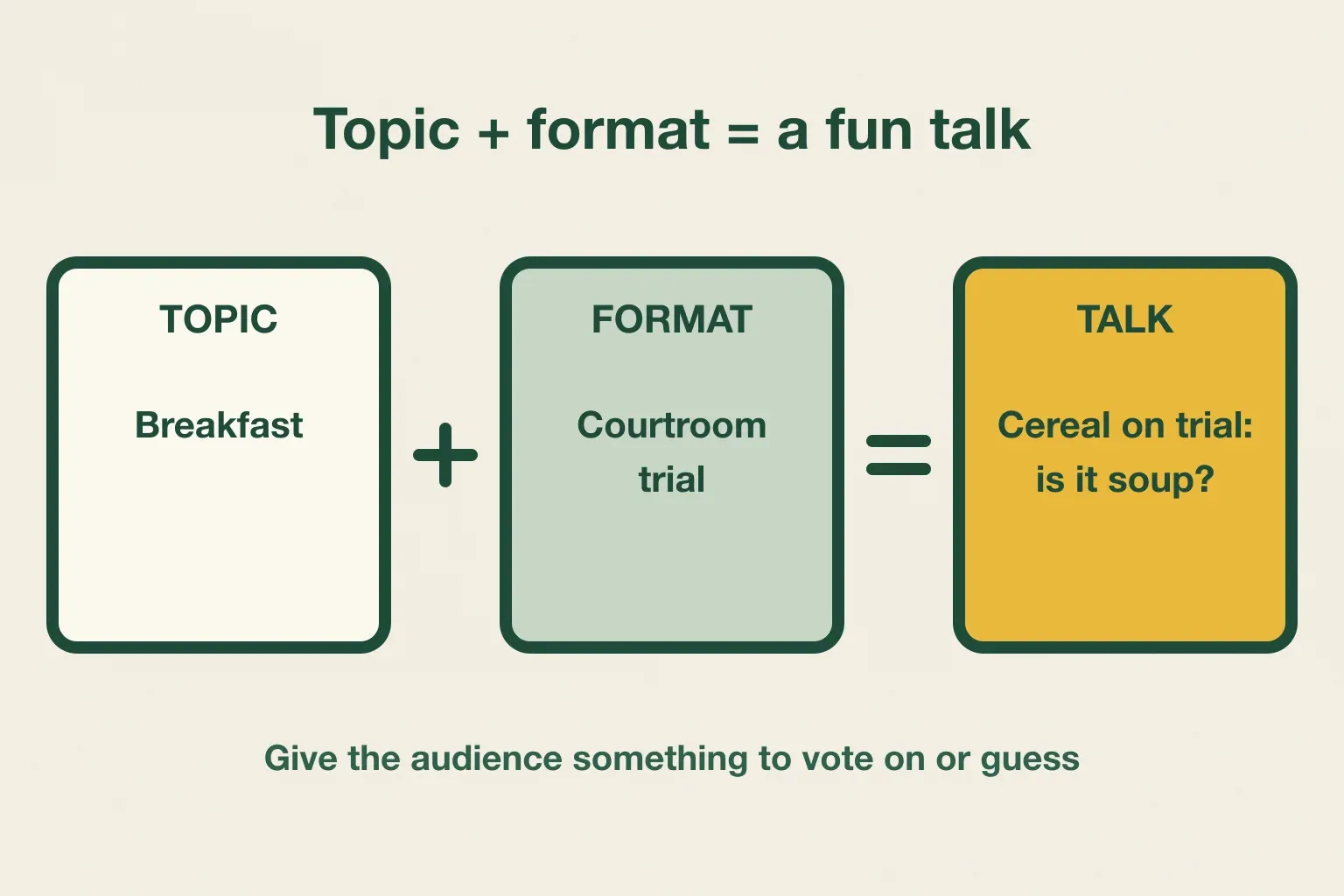
- The ranking. Rank five to ten things from worst to best, one per slide, saving the winner for last. Works for almost anything: foods, inventions, historical figures.
- The courtroom trial. Put something on trial (“Pineapple on pizza”), present evidence for both sides, and let the audience be the jury.
- The nature documentary. Narrate an everyday subject (your cat, your office, a school cafeteria) like a wildlife film.
- The fake TED talk. Treat something tiny with huge seriousness: a bold claim, a personal story, a big closing line.
- Myth or fact. Show a claim on each slide and let the audience guess before you reveal the answer. A set of Google Slides animations makes the reveal easy.
- The game show. Turn your points into quiz questions. Teams score on a whiteboard as you go.
- The before and after. Show how something changed: a town, a technology, a fashion, a friendship.
- The pitch. Sell an idea, product or plan as if the audience were investors, then let them vote.
The rule behind all eight: give the audience something to do or guess. People remember a talk they voted, guessed or laughed in far better than one they only watched.
How many slides for a fun presentation?
For a fun presentation, use more pictures and fewer words, so each slide goes faster. At a standard pace of one to two minutes a slide, and a visual pace of 30 to 60 seconds:
| Time | Standard deck | Visual deck (photos, one big word) |
|---|---|---|
| 3 minutes | 2 to 3 slides | 3 to 6 slides |
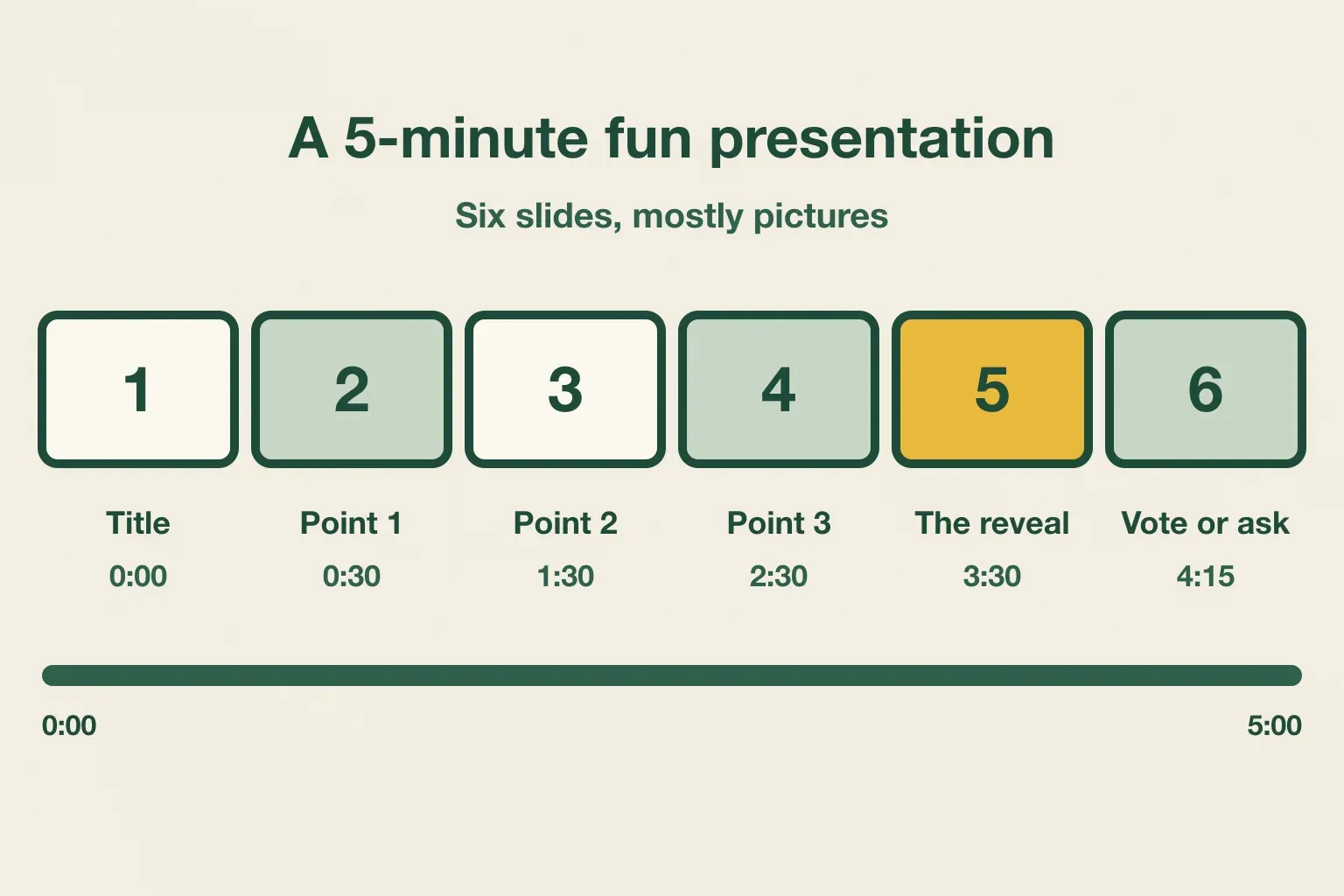
| 5 minutes | 3 to 5 slides | 5 to 10 slides |
| 10 minutes | 5 to 10 slides | 10 to 20 slides |
Most PowerPoint night talks are visual decks of 5 to 10 slides. For a class presentation, check whether the time limit includes questions. The 5-minute presentation and 10-minute presentation pages give a timed outline, and the slide count calculator works out any other length. If you’re writing out what you’ll say, the 3-minute speech and 5-minute speech pages show how many words fit.
How to make a fun presentation in an hour
- Pick the angle first (5 minutes). Write the topic and the twist in one line: “Cereal on trial: is it soup?” If you can’t, choose a format from the list above.
- Plan three or four points (10 minutes). One per slide or pair of slides. Put your best point or biggest surprise last.
- Find the pictures (20 minutes). One strong image per slide beats three small ones. Add a chart if the joke is a fake-serious one.
- Write the words (10 minutes). No more than a few words per slide; the rest goes in your speaker notes or on cue cards. The cue card maker formats them for printing.
- Rehearse once, with a timer (15 minutes). Say it out loud with a presentation timer and cut a point if you run over. End on a question or a vote, not “That’s it”.
To warm up before your turn, draw a random prompt from the impromptu speech topic generator and talk about it for a minute. If the group is new to each other, start the evening with a few icebreaker questions.
If the presentation needs to change someone’s mind rather than entertain them, see these persuasive speech topics. For two sides arguing it out, try the debate topics. To teach the room a skill step by step, pick one of these demonstration speech topics. When several people present from one Google Slides deck, each speaker can move the slides from their own phone instead of crowding the laptop: see how to control Google Slides from your phone.
Frequently asked questions
What is a fun topic for a presentation?
A fun topic is one the audience already has an opinion about, with a twist: “Is a hot dog a sandwich?”, “Ranking pizza toppings in court” or “The science of a perfect nap”. Pick something you can show with pictures and finish in three or four points.
What are good presentation ideas for students?
For younger students: “If I ran the school for a day”, “My dream treehouse” or “Why my favorite animal is the best”. For high school and college: “The psychology of procrastination”, “How a viral video goes viral” or “The economics of a concert ticket”. Choose one close to your own life so you have examples ready.
What should I present for PowerPoint night?
Something silly treated seriously: starter packs for everyone in the room, your group chat analyzed, your friends as a sitcom cast, or the case for your most unpopular opinion. Keep it to 3 to 5 minutes and 5 to 10 picture-heavy slides, and agree on off-limits topics before you start.
How do you make a presentation fun?
Use a format with a game in it: a ranking, a courtroom trial, a myth-or-fact quiz or a fake TED talk. Put pictures on the slides instead of text, save your biggest surprise for last, and end by asking the audience to vote or guess.
What are easy presentation topics?
Topics you already know: your hobby, your favorite food, your pet, a place you’ve visited or a skill you could teach in five minutes. Easy topics need little research, so you can spend your time on the pictures and the delivery.
How long should a fun presentation be?
Usually 3 to 5 minutes for PowerPoint night or a class, and up to 10 minutes for a work lunch-and-learn. Plan about one slide per 30 to 60 seconds if your slides are mostly pictures.