Updated · By Peter Kovalsky
150 Demonstration Speech Topics for Students, College and Work
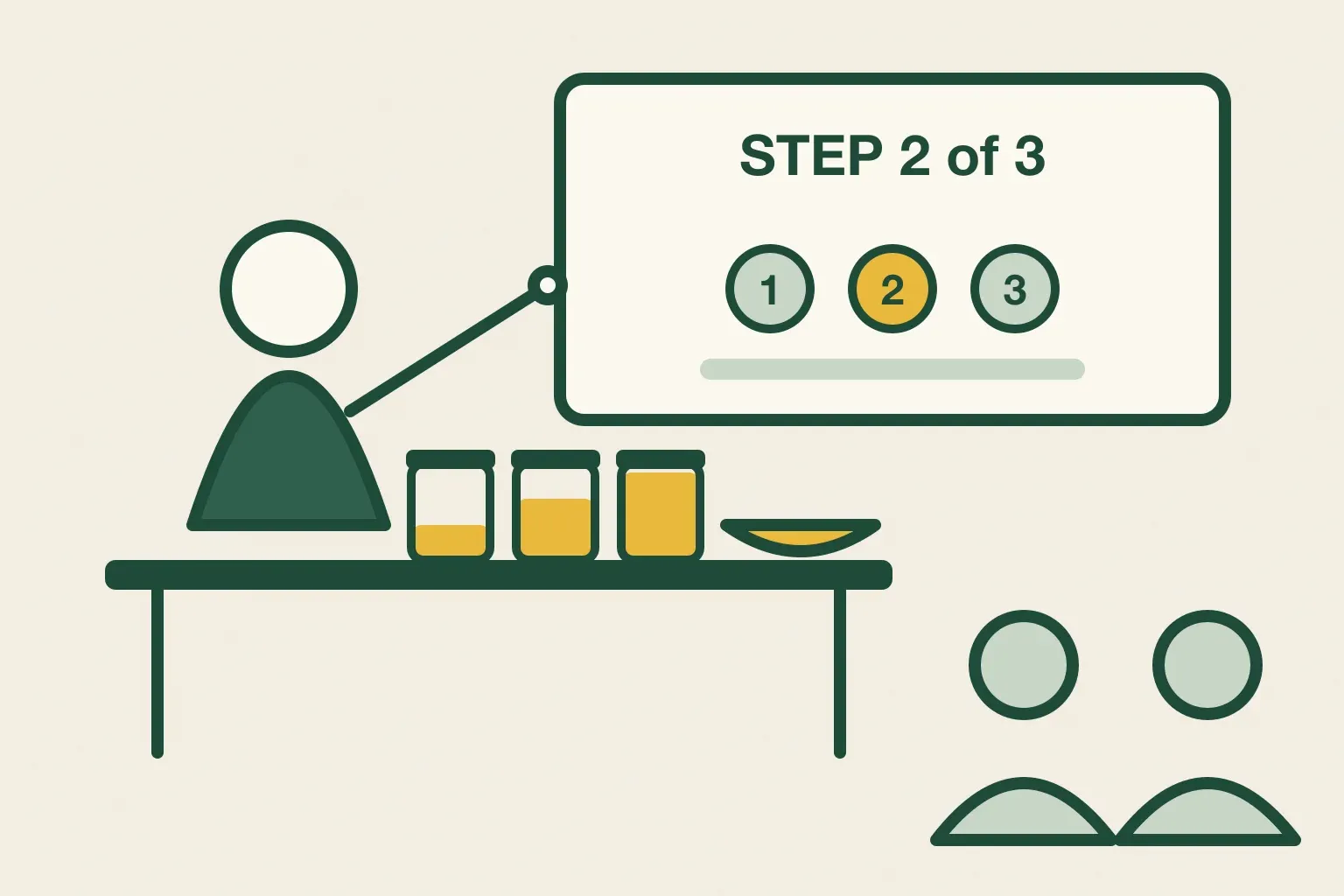
A demonstration speech teaches the audience how to do something by showing it, step by step. The best topic is a skill you can already do well, that fits into three to five clear steps, and that you can actually show in the room with real objects, pictures or a screen. This list has 150 demonstration speech topics, sorted by level (easy, middle school, high school, college, work) and then by theme. Each one has a one-line angle: what to show, so you know the steps before you start writing.
Below the lists you’ll find how to structure the speech, how many steps and words fit in 3, 5, 7 or 10 minutes, and how to handle props so the demo still works when your time is short.
What makes a good demonstration speech topic?
Check a topic against these four questions. If one answer is “no”, narrow it or pick another.
| Check | Ask | A topic that fails |
|---|---|---|
| You can do it | Have you done it often enough to show it without looking anything up? | A recipe you have never made |
| It fits the time | Can you show it in three to five steps in your time limit? | ”How to build a website” in five minutes |
| You can show it here | Can the back row see it, with props, photos or a screen? | ”How to fix a car engine” in a classroom |
| It is safe and allowed | Does it avoid open flames, sharp tools and food rules your school bans? | Anything with a stove, a blade or allergens, unless your teacher says yes |
Narrowing is the usual fix. “How to cook” is too big. “How to make overnight oats” is one jar, four ingredients and a clear finished result. If your teacher wants a real demonstration, choose a topic where the audience sees something change in front of them: a knot gets tied, a card gets folded, a formula fills a column.
Easy demonstration speech topics
Good for a first speech, elementary school or a short class demo. Each one needs a few cheap props and has an obvious finished result.
- How to tie your shoes two ways. The standard loop and “bunny ears”, slowed down.
- How to make a paper airplane that flies far. One design, folded live, then a test flight.
- How to brush your teeth properly. The angle, the circles and the time, shown on a big model or picture.
- How to wash your hands well. Soap, scrub and rinse, with glitter to show the spots people miss.
- How to make a friendship bracelet. A simple knot pattern with three colors of thread.
- How to plant a seed in a cup. Soil, depth, water and where to put the cup.
- How to fold a T-shirt in seconds. The pinch-and-flip fold, shown twice.
- How to make a fruit kebab. Soft fruit cut in advance and a color pattern on a blunt skewer.
- How to draw a cartoon cat with shapes. Circles and triangles, one shape at a time.
- How to pack a school bag. What goes in first, what stays on top and what stays home.
- How to make a pinecone bird feeder. Spread (sunflower butter if there are nut allergies), roll in seeds and hang.
- How to set a table. Where the fork, knife, spoon and glass go, and why.
- How to make a paper fortune teller. Fold it, number it and write the fortunes.
- How to care for a goldfish. Tank, food and cleaning, with photos of each step.
- How to wrap a present neatly. Measure the paper, fold the ends and hide the tape.
Demonstration speech topics for middle school
Topics with a satisfying result and a little science or skill behind them.
- How to make a stop-motion video on a phone. Ten photos, one tiny move each, then play it back.
- How to solve the first layer of a Rubik’s Cube. The white cross, then the corners.
- How to light an LED with a coin battery. Which leg goes where, and why the other way stays dark.
- How to do a simple card trick. Perform it once, then slowly show the secret.
- How to make a fruit smoothie. Fruit, liquid and ice, and how to fix one that is too thick.
- How to juggle three balls. One ball first, then two, then three.
- How to draw a comic strip. Panels, speech bubbles and a punchline in the last box.
- How to tie three useful knots. Square knot, clove hitch and bowline, each with a use.
- How to build a bottle water filter. Gravel, sand and charcoal layers, and why the water still isn’t safe to drink.
- How to build a balloon-powered car. Straws, bottle caps and a balloon, raced across the room.
- How to fold an origami jumping frog. Fold it live, then race two frogs.
- How to dribble a basketball. Fingertips, ball height and eyes up.
- How to make a strong password you can remember. The “three random words” method, and why length matters.
- How to fold a corner bookmark. One square of paper, four folds and a decoration.
- How to teach a dog to sit. Lure, reward and repeat, with a video clip or a stuffed dog.
- How to make a baking soda volcano. The reaction in one sentence and how to make it foam more.
- How to edit a photo on your phone. Crop, light and color, shown before and after.
- How to make a lava lamp in a bottle. Oil, water, food coloring and a fizzing tablet.
- How to draw in one-point perspective. A horizon, one vanishing point and a road.
- How to make a paper helicopter. Cut, fold and drop it from two heights.
Demonstration speech topics for high school
Practical skills students will use soon, from money to first jobs to safety.
- How to budget your first paycheck. Needs, wants and savings in a simple spreadsheet.
- How to change a flat tire. The jack points, the loosening order and the spare, shown with photos.
- How to jump-start a car. The cable order on a diagram, and why the last clamp goes on bare metal.
- How to write a résumé for your first job. One page, and what to list when you have no work history.
- How to cite a source. One book or article, cited in MLA and in APA side by side.
- How to do a proper push-up. Hands, back and elbows, plus an easier version.
- How to edit a short video. Cuts, music and captions in a free app.
- How to use a fire extinguisher. The PASS steps (pull, aim, squeeze, sweep), with pictures, not a real discharge.
- How to make cold brew coffee. Coarse grounds, cold water and an overnight wait, with a jar made the day before.
- How to take a good portrait with a phone. Light, background and where to stand.
- How to fold a fitted sheet. The corner tuck that turns it into a flat rectangle.
- How to make a study schedule. Study blocks, breaks and the week before a test.
- How to do Hands-Only CPR. The two steps the American Heart Association teaches, practiced on a pillow or a training manikin.
- How to sew on a button. Thread, needle and the wrap underneath that keeps it on.
- How to read a nutrition label. Serving size first, then the numbers that matter most.
- How to record a podcast on a phone. Mic distance, a quiet room and a simple edit.
- How to tie a tie. The four-in-hand knot, shown facing the same way as the audience.
- How to shuffle cards like a dealer. The riffle and the bridge.
- How to work out a tip in your head. Find 10%, then double it or add half.
- How to prepare for a job interview. Research, three stories about yourself and two questions to ask.
Demonstration speech topics for college
Skills that save time in college and after it, with enough depth for a public speaking class.
- How to read a research paper quickly. Abstract, figures and conclusion first, methods last.
- How to make a pivot table. Turn a messy list of rows into a summary in a minute.
- How to brew pour-over coffee. The bloom, the pour and the timing, with a scale.
- How to negotiate a job offer. What to ask for, how to ask and what to say if they say no.
- How to read your first pay stub. Gross pay, deductions and net pay, line by line.
- How to build a budget spreadsheet that adds itself up. Categories, a SUM formula and one chart.
- How to plan a week of meal prep. One shopping list, three recipes and five lunches.
- How to give a 30-second elevator pitch. Who you are, what you do and what you want. The elevator pitch builder gives you the structure.
- How to use a citation manager. Save a source, then insert it into a paper.
- How to back up a laptop. The 3-2-1 rule: three copies, two kinds of storage, one somewhere else.
- How to roll sushi. Rice, nori and the mat, with cooked or vegetable fillings.
- How to do a sun salutation. Each yoga pose in order, and the breath that goes with it.
- How to design a clear slide. One idea, one picture and big text, before and after. More in how to make Google Slides look good.
- How to build a one-page website. A free builder, a headline, one photo and a contact button.
- How to take notes with the Cornell method. The cue column, the notes and the summary at the bottom.
- How to spot a phishing email. The sender, the link and the urgent tone, on a real example.
- How to put a bike chain back on. Shift to the smallest gear, hook the chain and turn the pedal.
- How to mix any color from three paints. Primary colors, tints and shades on a paper palette.
- How to make a time-lapse video. A phone stand, the setting and what to film.
- How to arrange a snack board. Grouping by color and shape, with everything cut in advance.
Demonstration speech topics for work
For team meetings, onboarding, lunch-and-learns and training sessions. Choose a skill your colleagues will use the same week.
- How to run a 15-minute stand-up. Three questions per person and a timer.
- How to write an email people answer. A clear subject line, one ask and a deadline.
- Five keyboard shortcuts that save time. In the tool the team uses most. For decks, see these Google Slides keyboard shortcuts.
- How to look and sound good on a video call. Light in front, camera at eye level and a headset mic.
- How to give feedback with the SBI model. Situation, behavior and impact, with one example.
- How to make a one-page project plan. Goal, owners, dates and risks.
- How to share your screen without showing everything. One window only, with notifications off.
- How to record a quick explainer video. Screen recording with your voice, kept under two minutes. See how to record a Google Slides presentation.
- How to set up a desk that doesn’t hurt. Screen height, chair height and where your wrists go.
- How to build a simple dashboard. Three numbers that matter, where they come from and one chart each.
- How to onboard a new teammate. A first-week checklist, a buddy and a first small task.
- How to write a meeting agenda. Topics, owners and minutes for each item. The agenda builder adds up the times.
- How to hand over between co-presenters. Who speaks when and how to pass the slides. More in these co-presenter tips.
- How to brainstorm with sticky notes. Silent writing, grouping and dot voting.
- How to take a useful screenshot. Crop it, mark it up and blur private details.
Demonstration speech topics by theme
When the audience is mixed, pick by theme instead of level. Most of these work from high school to adults.
Food and drink (no stove needed)
- How to make guacamole. Avocados halved in advance, mashed with a fork and seasoned to taste.
- How to make overnight oats. Oats, milk and toppings in a jar, with a finished jar made the night before.
- How to roll a wrap that doesn’t fall apart. The fold-the-bottom-first method.
- How to make lemonade from scratch. Lemons, sugar and water, tasted and adjusted.
- How to pipe frosting on a cupcake. A star tip, one swirl and sprinkles.
- How to keep a fruit salad fresh. Which fruits turn brown and how a little lemon juice slows it.
- How to make no-bake energy balls. Oats, honey and a seed butter, rolled by hand.
- How to layer a yogurt parfait. Yogurt, fruit and granola in a clear cup.
- How to brew loose-leaf tea. Water temperature and steeping time for green, black and herbal tea.
- How to make a mug cake. Mix it in the mug, then one minute in a microwave.
Home and life skills
- How to iron a shirt. Collar, cuffs, sleeves, then the body.
- How to unclog a sink without chemicals. A plunger and the trap under the sink, shown with photos.
- How to do laundry without ruining clothes. Sort, read the care label and pick the setting.
- How to pack a carry-on for a week. Rolling versus folding, and what to leave out.
- How to change a light bulb safely. Power off, wait for it to cool and pick the right bulb.
- How to clean white sneakers. A brush, soap and the laces washed separately.
- How to make a bed with hospital corners. The fold that keeps the sheet tight.
- How to use a map and compass. Turn the map to north, then take a bearing.
- How to hang a picture straight. Measure, mark and check with a level.
- How to repot a houseplant. Drainage, fresh soil and how deep to plant it.
Technology and phones
- How to add speaker notes in Google Slides. Type them, then see them in presenter view. Step by step: how to add speaker notes in Google Slides.
- How to add a timer to Google Slides. Three ways, shown on one slide. See how to add a timer to Google Slides.
- How to make a QR code for a link. Create it, test it with a phone and print it.
- How to turn on two-step verification. An authenticator app code, shown on a test account.
- How to use your phone’s accessibility settings. Bigger text, the magnifier and live captions.
- How to make a GIF from a video. Trim it, add a caption and keep the file small.
- How to free up space on your phone. Find the biggest apps, then old videos.
- How to animate a slide. One object appearing on click, then a full sequence. Details in Google Slides animations.
- How to look up a value in a spreadsheet. XLOOKUP or VLOOKUP on a small price list.
- How to control slides from your phone. Pair the phone, then move forward and back while you walk. See how to control Google Slides from your phone.
Arts and crafts
- How to write brush-pen calligraphy. Thick lines going down, thin lines going up.
- How to make a pop-up card. Two cuts, one fold and a picture glued on the tab.
- How to knit the basic stitch. Cast on and knit one row with thick yarn and big needles.
- How to make a clay pinch pot. A ball, a thumb hole and even walls.
- How to draw a face in proportion. The eyes go halfway down the head, then the nose and mouth.
- How to paint a watercolor wash. Wet on wet versus wet on dry, side by side.
- How to tie-dye a shirt. The spiral fold and the bands, with a finished shirt to show.
- How to bind a small book. A pamphlet stitch with a needle and thread.
- How to make a collage that looks planned. A color scheme, layers and one main image.
- How to make a paper lantern. Fold, cut the slits and join the ends.
Sports and health
- How to warm up before a run. Five minutes of moving stretches, not holding them.
- How to shoot a free throw. Balance, eyes on the rim, elbow in and follow through.
- How to serve a volleyball underhand. Stance, the toss and where your hand hits the ball.
- How to stretch after exercise. Five stretches and how long to hold each.
- How to fit a bike helmet. Level on the head, straps in a V and a snug chin strap.
- How to throw a football spiral. Fingers on the laces and the release.
- How to hold a plank. A straight line from head to heels, and an easier version.
- How to hit a tennis forehand. Grip, turn and swing, shown slowly.
- How to calm your nerves before a speech. Slow breathing with a longer breath out.
- How to pack a first aid kit. What goes in, from bandages to tweezers, and where to keep it.
Science experiments
- How to make a rainbow with a glass of water. A glass, a flashlight or sunny window and white paper.
- How to extract DNA from a strawberry. Dish soap, salt and cold rubbing alcohol, with no flames nearby.
- How to write with invisible ink. Lemon juice on paper, revealed with a lamp or an adult’s iron.
- How to make a compass with a needle. Magnetize it, float it on a cork and watch it turn.
- How to grow salt or sugar crystals. The solution, a string and a jar grown a few days in advance.
- How to hold water in an upside-down glass. A card, a full glass and air pressure.
- How to make an electromagnet. A nail, wire and a battery, then count the paper clips it lifts.
- How to test acids and bases with red cabbage. Cabbage juice changes color in vinegar and in baking soda water.
- How to build a paper bridge that holds coins. Flat versus folded paper, tested with coins.
- How to bend water with a balloon. Rub a balloon on your hair and hold it near a thin stream from a tap.
How to structure a demonstration speech
Most demonstration speeches follow the same five parts. The steps are the middle, and they get most of the time.
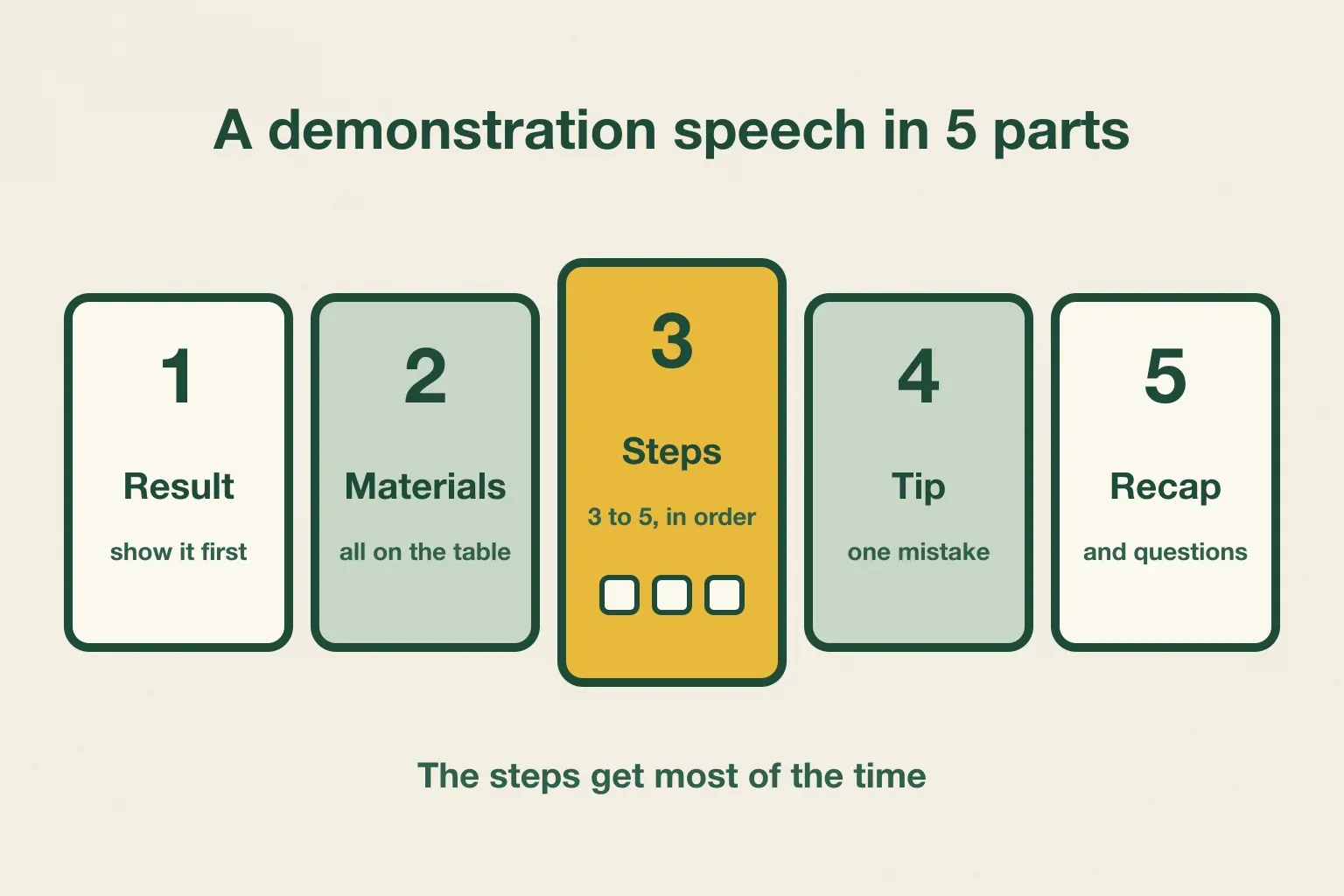
- Show the finished result. Open with the thing the audience will learn to make or do, and why it’s useful. “By the end you’ll be able to tie a tie in under a minute.”
- List the materials. Show everything on the table, or on one slide. The audience can’t follow a step if they don’t know what the tool is.
- Show the steps. Three to five steps, in order. For each one: say what you’re doing, do it where everyone can see, then say why it matters or what goes wrong.
- Give one tip. The mistake beginners make most, or the trick that makes it easier.
- Recap and take questions. Repeat the steps in one line each and show the finished result again.
Number the steps out loud (“Step two of four”). It tells the audience where they are and stops the speech from feeling like one long ramble.
How long should a demonstration speech be?
Most class demonstration speeches are 3 to 7 minutes. Because part of the time you are showing rather than talking, write fewer words than you would for a normal speech of the same length. At an average pace of 130 words a minute:
| Length | Steps | Words, talking only | Words with demo time |
|---|---|---|---|
| 3 minutes | 2 to 3 | 390 | 260 (1 min demo) |
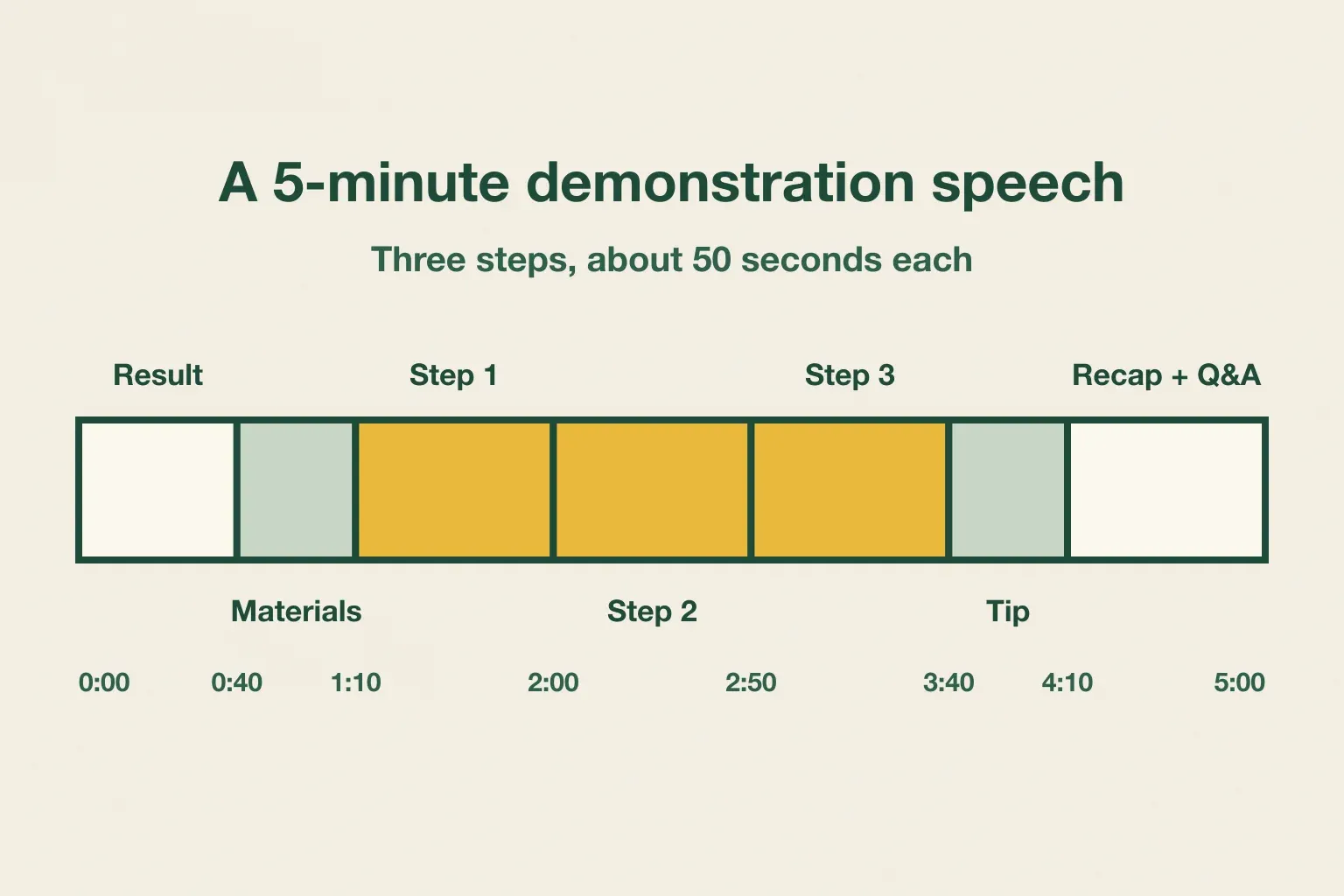
| 5 minutes | 3 to 4 | 650 | 390 (2 min demo) |
| 7 minutes | 4 to 5 | 910 | 650 (2 min demo) |
| 10 minutes | 5 to 6 | 1,300 | 910 (3 min demo) |
The speech time calculator does this for any length: enter your time limit, add your demo minutes under “Add Q&A, demos or pauses”, and it tells you how many words fit. The 3-minute speech, 5-minute speech and 7-minute speech pages each give a timed outline.
Props, visuals and the cooking-show trick
The demo is the part most likely to go wrong, and the part the audience remembers. Plan it as carefully as the words.
- Prepare stages in advance. Cooking shows don’t wait for the cake to bake. Bring the result of each slow step already done: the jar of overnight oats from last night, the crystals that took three days, the shirt already dyed.
- Make it big enough to see. Hold small things up, use large props, or point a phone camera at the table and show it on the screen.
- Use slides when you can’t bring it. For a tire, a car battery or a fire extinguisher, put one photo of each step on a slide. A slide also helps the back row see a small step.
- Rehearse with the real materials. Do the full demo at least twice. Things take longer with an audience watching.
- Plan for a step that fails. Have a finished example ready, say what went wrong and keep going. That’s often the most useful moment of the speech.
- Check the rules. Ask before bringing food, heat, sharp tools, animals or anything that spills.
How to practice a demonstration speech
Put each step on a cue card in a few words, so you can glance down without losing your place. The presentation cue card maker formats them for printing. Then rehearse the full demo, out loud, with a presentation timer, and cut a step if you run over.
If you give the demo with slides, your hands are usually busy with the props. Instead of going back to the laptop between steps, you can move the slides and read your notes from a phone: see how to control Google Slides from your phone and how to see your speaker notes on your phone.
To warm up before your turn, draw a random prompt from the impromptu speech topic generator and talk about it for a minute. If you need to change minds rather than teach a skill, use these persuasive speech topics. For something lighter, try these fun presentation topics.
Frequently asked questions
What is a demonstration speech?
A demonstration speech teaches the audience how to do something by showing the steps as you explain them. It usually uses props, pictures or a screen, and ends with the finished result. It’s sometimes called a “how-to” or process speech.
What are good demonstration speech topics?
Skills you already do well, that fit into three to five steps and that you can show in the room: how to tie a tie, how to fold an origami frog, how to make a pivot table, how to do Hands-Only CPR or how to make overnight oats.
What are easy demonstration speech topics?
Topics with cheap props and a clear result: how to make a paper airplane, fold a T-shirt in seconds, make a friendship bracelet, plant a seed in a cup or wrap a present neatly.
How long is a demonstration speech?
Usually 3 to 7 minutes for a class. Plan two or three steps for 3 minutes, three or four for 5 minutes and four or five for 7 minutes, and write fewer words than a normal speech because part of the time you are showing, not talking.
What is the difference between a demonstration speech and an informative speech?
A demonstration speech teaches the audience to do something, step by step, and shows it. An informative speech explains a topic, such as how bees communicate, without the audience needing to do anything afterward.
Can I use slides in a demonstration speech?
Yes. Slides help when the object is too big, unsafe or too small to show in the room. Put one photo and a few words for each step, and keep the real demo on the table where you can.