Updated · By Peter Kovalsky
How to Start a Presentation: 12 Ways to Open, With Examples

The best way to start a presentation is to skip the warm-up and open with something about the audience: a question, a short story, a surprising fact or a problem they already have. Then say in one sentence why it matters to them and what the talk will cover. Introduce yourself after that, in a single line. The whole opening takes about 30 seconds, which is roughly 65 words at an average speaking pace.
Below are 12 ways to open, each with an example line you can adapt for a class presentation, a work meeting or a pitch, plus a simple structure for the first 30 seconds and the openings to avoid.
How do you start a presentation? The first 30 seconds
Most strong openings follow the same three steps. The exact words change; the order doesn’t.
- The hook (about 15 seconds). One thing that makes people look up: a question, a story, a fact, a picture. Pick one of the 12 below.
- Why it matters to them (about 5 seconds). Connect the hook to the people in the room. “If you’ve ever…”, “This affects every team that…”, “By the end of this, you’ll be able to…”
- The roadmap (about 10 seconds). Say what’s coming, in three parts at most. “First…, then…, and finally…”
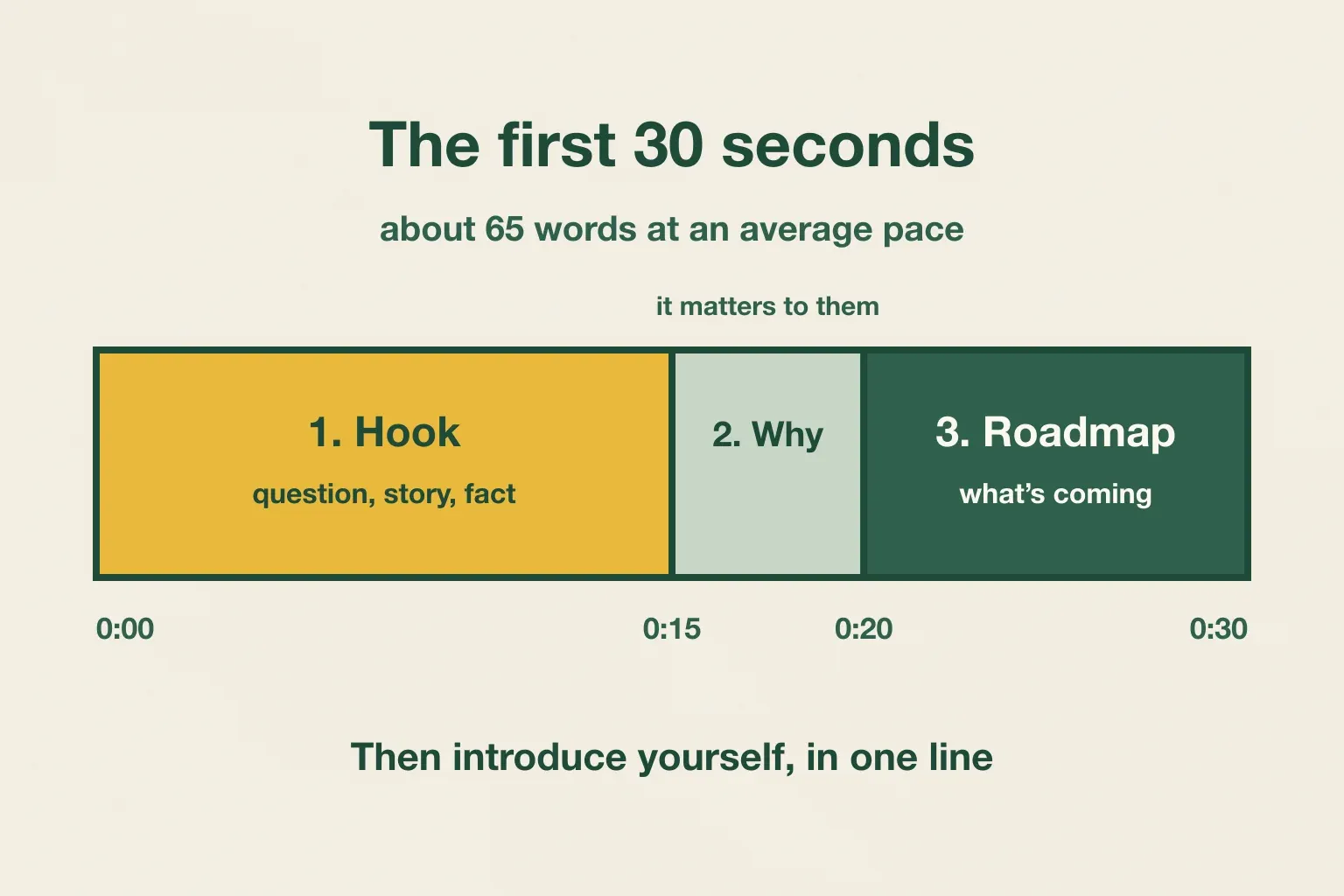
Here is the full structure in a hypothetical 5-minute class presentation on recycling:
“Raise your hand if you’ve ever stood at a bin, not sure if something could be recycled. [pause] Last week I sorted our classroom bin, and a third of it was in the wrong place. In the next five minutes I’ll show you where our recycling goes, the three items we get wrong most, and one change we could make tomorrow.”
That’s 60 words, and the speaker hasn’t said their name yet. In a class where everyone knows you, you don’t need to.
12 ways to start a presentation, with examples
Each opening type below has an example line. Swap in your own topic; keep the shape.
1. Ask the audience a question
A question makes everyone answer in their head, even if nobody speaks. Ask something they can answer from their own life, then pause for two or three seconds before you go on.
- Class: “How many hours of sleep did you get last night? Hold that number in your head.”
- Work: “When did a meeting last end early?”
- Pitch: “How do you find out a customer is unhappy: before they leave, or after?”
Avoid questions with an obvious answer (“Who here likes money?”). They sound like a sales trick.
2. Ask for a show of hands
A show of hands turns a question into something the whole room does, and you learn who you are talking to. It works best with a yes-or-no question that splits the room.
- “Raise your hand if you’ve ever missed a bus by less than a minute.”
- “Hands up if you’ve used the new booking system at least once.”
Look around, say what you see (“About half of you”), and use it in your next sentence.
3. Tell a short story
A story pulls people in faster than any fact. Keep it under 30 seconds, make it about one person in one moment, and stop at the point where it connects to your topic.
- “Last March, our delivery driver Sam waited 40 minutes outside a locked gate, with a van full of frozen food.”
- “When my grandmother arrived in this country, she had one suitcase and a recipe book.”
The best stories are your own. A story about a real person needs their permission if they could be recognised.
4. Start with “Imagine…”
Ask the audience to picture a situation. It’s a story they star in, which makes it easy for anyone, including younger students.
- “Imagine you wake up tomorrow and every screen in your house has stopped working.”
- “Imagine it’s the end of next quarter, and every customer call is answered within a minute.”
Keep the picture short and concrete: one place, one moment, one detail they can see.
5. Share a surprising fact or number
A fact that goes against what people expect makes them want the explanation. Use one number, not three, and say where it comes from.
- “A teaspoon of soil can hold more living things than there are people on Earth.” (Then name your source.)
- “Last month, 4 out of 10 support tickets were about the same password screen.” (From your own data.)
Check every fact against a reliable source before you use it. A wrong number in the first sentence costs you the rest of the talk. Your own data, from your team, class or survey, is often the most surprising and the easiest to stand behind.
6. Name a problem they already have
Start where the audience is: a frustration they’ll recognise. Then your talk is the way out.
- “Every Friday, someone asks where the latest version of the report is.”
- “Group projects usually go wrong in the same place: the last two days.”
This is the most reliable opening for work meetings and internal updates, because the problem is the reason everyone is there.
7. Make a bold statement
Say something strong that you will then prove. It works when you can back it up in the next few minutes.
- “Homework should be banned in primary school.”
- “Our biggest competitor isn’t a company. It’s a spreadsheet.”
A bold opening suits persuasive speeches and debates. If you need a position to argue, these persuasive speech topics and debate topics give you a strong first line.
8. Use a quote, briefly
A quote can work if it’s short, surprising and says something you will build on. Avoid the famous ones everyone has heard, and check who really said it: many quotes online are credited to the wrong person.
- “My coach used to say: ‘Nobody remembers the warm-up.’”
A line from someone the audience knows (a teacher, a customer, a colleague) often lands better than a famous name. Quote it exactly and say who said it.
9. Show a picture
Put a single striking image on your first slide and say nothing for two seconds. Then say what it is. The picture does the hooking, so the words can be simple.
- A photo of the school car park at 8:25 a.m., then: “This is what the drop-off looks like every morning.”
- A chart with one line going straight up, then: “This is our support queue since June.”
Keep the first slide free of text, so people look at the picture and listen to you, not read.
10. Hold up an object
A real object in your hand is hard to ignore. It works especially well in class presentations and demonstration speeches.
- Hold up a plastic bottle: “Our class threw away 60 of these last week. I counted.”
- Hold up an old phone: “This was the newest phone in our office in 2015.”
Show it, say one line, and put it down where people can still see it.
11. Promise what they’ll get
Tell the audience exactly what they’ll be able to do by the end. It’s the plainest opening, and for busy people it’s often the best one.
- “In ten minutes you’ll know how to read your payslip, line by line.”
- “By the end of this meeting, we’ll have chosen one of the three designs.”
This opening works well when the room is short on time, or when the talk is training rather than persuasion.
12. Start with the ending
Give the conclusion or the result first, then explain how you got there. People listen for the “how”.
- “We cut our printing costs in half. Here’s the one thing we changed.”
- “The answer to our research question was no. What surprised us was why.”
This suits reports, project updates and science presentations, where the audience wants the result before the method.
Which opening fits your presentation?
| Presentation | Openings that work well | Example first line |
|---|---|---|
| Class presentation | Question, show of hands, “Imagine…”, object | ”Raise your hand if you’ve ever lost a sock in the wash.” |
| Book report or project | Short story, surprising fact, picture | ”In 1912, a ship that couldn’t sink did.” |
| Work meeting or update | Problem, promise, start with the ending | ”Every Friday, someone asks where the latest report is.” |
| Pitch or sales talk | Problem, question, surprising fact (your data) | “How do you find out a customer is unhappy?” |
| Persuasive speech or debate | Bold statement, question, story | ”Homework should be banned in primary school.” |
| Training or workshop | Promise, show of hands | ”In 20 minutes you’ll set this up on your own laptop.” |
| Online meeting | Question with a chat reply, picture, problem | ”Type one word in the chat: how was your week?” |
For a classroom warm-up, a quick question from the icebreaker question generator can be a good way to start. It also works for workshops and team meetings, before the talk itself begins.
When should you introduce yourself?
After the hook, not before. Your name and job title are rarely the most interesting thing you can say first, and the audience pays the most attention in the first few seconds.
Once the hook has landed, give one line on who you are and why you’re the one talking:
- “I’m Priya, and I’ve been tracking our recycling bins for three weeks.”
- “I’m Tom from the support team. I read every one of those tickets.”
Skip it altogether if everyone in the room already knows you. If someone introduces you, thank them in a few words and go straight to your hook.
How not to start a presentation
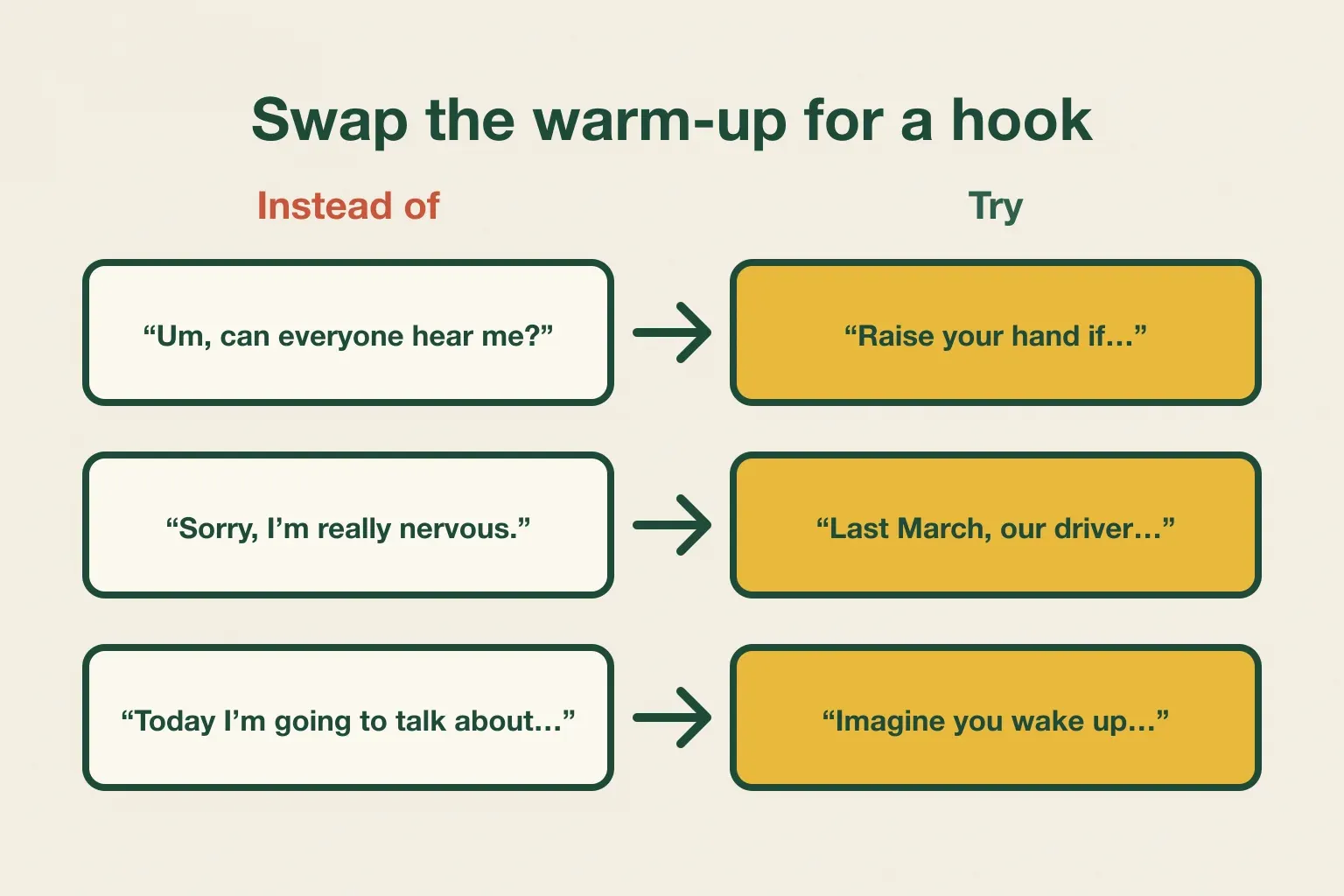
These openings waste the moment when people are paying the most attention:
- “Um, so… can everyone hear me?” Check the microphone and the slides before people arrive. If you must check, do it before you start, then start properly.
- Apologising. “Sorry, I didn’t have much time to prepare” or “I’m really nervous” makes the audience look for problems. They usually can’t tell you’re nervous.
- Reading the title slide. Everyone can read it. Say something it doesn’t.
- A long thank-you list. One short thank-you is polite. Five names before the first idea is a lost minute.
- “Today I’m going to talk about…” It’s not wrong, just flat. Put a hook in front of it and keep it as your roadmap line.
- A joke you’re not sure about. If it falls flat, you start from behind. A light, true story is safer than a joke.
- Fighting the technology. Searching for the file or the full screen button in front of everyone is the most common weak start of all.
How to get the first minute right
The opening is the part of the talk most worth practising, because nerves are strongest in the first minute. A few habits help:
- Learn your first three sentences by heart. Not the whole talk, just the opening. Once you’re through it, the rest comes more easily.
- Say them out loud, timed. Read the opening aloud and time it. At an average pace of 130 words a minute, a 30-second opening is about 65 words. The speech time calculator shows how long any script takes, and the speaking pace test measures your own speed.
- Keep the opening to about a tenth of the talk. 20 to 30 seconds for a 2-minute speech, under a minute for a 10-minute presentation. A presentation timer on a second screen tells you if you’re running long.
- Put the first line in your notes, word for word. Write the rest as short prompts. Cue cards or speaker notes on your phone keep it in your hand without reading from the screen.
- Pause before your first word. Stand still, look at the audience, take one breath, then speak. A two-second silence feels long to you and normal to everyone else.
- Have the slides ready before you’re introduced. Open the deck in Presenter View on the first slide so you can start the moment you stand up.
Starting a Google Slides presentation
If you present from Google Slides, set it up so the first thing anyone sees is your opening, not your browser:
- Open the deck a few minutes early and go to the first slide.
- In Chrome, click the ▾ arrow next to Slideshow, then Presentation display options → Presenter view. The audience sees the slides full screen, and your notes, a timer and the next slide stay in a separate window.
- Put your opening slide up before you start speaking: a single picture, a question, or just the title.
- Step away from the laptop for your hook. A remote, or your phone as a remote, lets you move to the next slide from where you stand.
How to end a presentation, too
A good opening sets up the ending. If you started with a question, answer it at the end. If you started with a story, finish it. If you made a promise, show that you kept it. The audience remembers the first and the last thing you say, so plan both before you plan the middle.
For eight ways to close, with example lines, what to put on your last slide and how to fit questions in, see how to end a presentation.
Frequently asked questions
What is the best way to start a presentation?
Open with a hook about the audience, such as a question, a short story, a surprising fact or a problem they have. Then say in one sentence why it matters to them and what you’ll cover. Introduce yourself after the hook, in one line.
What should I say first in a presentation?
Your hook, not your name. For example: “Raise your hand if you’ve ever missed a bus by less than a minute.” Learn that first sentence by heart so you can say it without notes.
How do you start a presentation for school?
A question to the class, a show of hands, an “Imagine…” scenario or an object you hold up all work well. Keep it short, connect it to your topic in the next sentence, and skip the introduction if the class already knows you.
How long should the opening of a presentation be?
About a tenth of the talk: around 30 seconds for a 5-minute presentation and under a minute for a 10-minute one. At an average speaking pace of 130 words a minute, 30 seconds is about 65 words.
Should you start a presentation with a joke?
Only if you’re sure it works for this audience and it connects to your topic. A joke that falls flat makes a hard start. A short, true, slightly funny story is a safer choice.
How do you start a presentation without being nervous?
You can’t remove the nerves, but you can make the first minute easy: learn the first three sentences by heart, have your slides ready before you stand up, pause and breathe before you speak, and open with a question, so the audience is thinking instead of watching you.